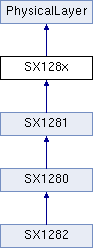
Base class for SX128x series. All derived classes for SX128x (e.g. SX1280 or SX1281) inherit from this base class. This class should not be instantiated directly from Arduino sketch, only from its derived classes. More...
#include <SX128x.h>
Public Member Functions | |
| SX128x (Module *mod) | |
| Default constructor. | |
| int16_t | begin (const ConfigLoRa_t &config) |
| Initialization method for LoRa modem. | |
| int16_t | beginGFSK (const ConfigFSK_t &config) |
| Initialization method for GFSK modem. | |
| int16_t | beginBLE (const ConfigBLE_t &config) |
| Initialization method for BLE modem. | |
| int16_t | beginFLRC (const ConfigFLRC_t &config) |
| Initialization method for FLRC modem. | |
| int16_t | reset (bool verify=true) |
| Reset method. Will reset the chip to the default state using RST pin. | |
| int16_t | transmit (const uint8_t *data, size_t len, uint8_t addr=0) override |
| Blocking binary transmit method. Overloads for string-based transmissions are implemented in PhysicalLayer. | |
| int16_t | receive (uint8_t *data, size_t len, RadioLibTime_t timeout=0) override |
| Blocking binary receive method. Overloads for string-based transmissions are implemented in PhysicalLayer. | |
| int16_t | transmitDirect (uint32_t frf=0) override |
| Starts direct mode transmission. | |
| int16_t | receiveDirect () override |
| Starts direct mode reception. Only implemented for PhysicalLayer compatibility, as SX128x series does not support direct mode reception. Will always return RADIOLIB_ERR_UNKNOWN. | |
| int16_t | scanChannel () override |
| Performs scan for LoRa transmission in the current channel. Detects both preamble and payload. | |
| int16_t | scanChannel (const ChannelScanConfig_t &config) override |
| Performs scan for LoRa transmission in the current channel. Detects both preamble and payload. | |
| int16_t | sleep () override |
| Sets the module to sleep mode. To wake the device up, call standby(). Overload for PhysicalLayer compatibility. | |
| int16_t | sleep (bool retainConfig) |
| Sets the module to sleep mode. To wake the device up, call standby(). | |
| int16_t | standby () override |
| Sets the module to standby mode (overload for PhysicalLayer compatibility). Uses 13 MHz RC oscillator by default, or external oscillator if standbyXOSC is set to true. | |
| int16_t | standby (uint8_t mode) override |
| Sets the module to standby mode. | |
| int16_t | standby (uint8_t mode, bool wakeup) |
| Sets the module to standby mode. | |
| void | setDio1Action (void(*func)(void)) |
| Sets interrupt service routine to call when DIO1 activates. | |
| void | clearDio1Action () |
| Clears interrupt service routine to call when DIO1 activates. | |
| int16_t | finishTransmit () override |
| Clean up after transmission is done. | |
| int16_t | startReceive () override |
| Interrupt-driven receive method with default parameters. Implemented for compatibility with PhysicalLayer. | |
| uint16_t | getIrqStatus () |
| Reads the current IRQ status. | |
| int16_t | readData (uint8_t *data, size_t len) override |
| Reads data received after calling startReceive method. When the packet length is not known in advance, getPacketLength method must be called BEFORE calling readData! | |
| int16_t | finishReceive () override |
| Clean up after reception is done. | |
| uint32_t | getIrqFlags () override |
| Read currently active IRQ flags. | |
| int16_t | setIrqFlags (uint32_t irq) override |
| Set interrupt on DIO1 to be sent on a specific IRQ bit (e.g. RxTimeout, CadDone). | |
| int16_t | clearIrqFlags (uint32_t irq) override |
| Clear interrupt on a specific IRQ bit (e.g. RxTimeout, CadDone). | |
| int16_t | startChannelScan () override |
| Interrupt-driven channel activity detection method. DIO1 will be activated when LoRa preamble is detected, or upon timeout. | |
| int16_t | startChannelScan (const ChannelScanConfig_t &cfg) override |
| Interrupt-driven channel activity detection method. DIO1 will be activated when LoRa preamble is detected, or upon timeout. | |
| int16_t | getChannelScanResult () override |
| Read the channel scan result. | |
| int16_t | setFrequency (uint32_t freq) override |
| Sets carrier frequency. Allowed values are in range from 2400 to 2500 MHz. | |
| int16_t | setBandwidth (uint32_t bw) override |
| Sets LoRa bandwidth. Allowed values are 203125, 406250, 812500 and 1625000 Hz. | |
| int16_t | setSpreadingFactor (uint8_t sf) override |
| Sets LoRa spreading factor. Allowed values range from 5 to 12. | |
| int16_t | setCodingRate (uint8_t cr, bool longInterleaving=false) override |
| Sets LoRa coding rate denominator. Allowed values range from 4 to 8. Note that a value of 4 means no coding, is undocumented and not recommended without your own FEC. | |
| int16_t | setOutputPower (int8_t power) override |
| Sets output power. Allowed values are in range from -18 to 13 dBm. | |
| int16_t | setModem (ModemType_t modem) override |
| Set modem for the radio to use. Will perform full reset and reconfigure the radio using its default parameters. | |
| int16_t | getModem (ModemType_t *modem) override |
| Get modem currently in use by the radio. | |
| int16_t | getMode (RadioModeType_t *mode) override |
| Read the operating mode the radio is in, as the chip reports it. Unlike PhysicalLayer::stagedMode, which is what was last asked of the radio, this reads the hardware, so a caller can tell a radio that has left a mode on its own - a receive that did not survive a frame, or a chip that lost its state - from one that is still in it. | |
| int16_t | setPreambleLength (size_t len, size_t detLen=0) override |
| Sets preamble length for currently active modem. Allowed values range from 1 to 65535. | |
| int16_t | checkDataRate (DataRate_t dr, ModemType_t modem=RADIOLIB_MODEM_NONE) override |
| Check the data rate can be configured by this module. | |
| int16_t | setBitRate (uint32_t br) override |
| Sets FSK or FLRC bit rate. Allowed values are 125, 250, 400, 500, 800, 1000, 1600 and 2000 kbps (for FSK modem) or 260, 325, 520, 650, 1000 and 1300 (for FLRC modem). | |
| int16_t | setFrequencyDeviation (uint32_t freqDev) override |
| Sets FSK frequency deviation. Allowed values range from 0 to 3200 kHz. | |
| int16_t | setDataShaping (uint8_t sh) override |
| Sets time-bandwidth product of Gaussian filter applied for shaping. Allowed values are RADIOLIB_SHAPING_0_5 or RADIOLIB_SHAPING_1_0. Set to RADIOLIB_SHAPING_NONE to disable data shaping. | |
| int16_t | setSyncWord (uint8_t *sync, size_t len) override |
| Sets FSK/FLRC sync word in the form of array of up to 5 bytes (FSK). For FLRC modem, the sync word must be exactly 4 bytes long. | |
| int16_t | setSyncWord (uint8_t syncWord, uint8_t controlBits=0x44) |
| Sets LoRa sync word. | |
| int16_t | setCRC (uint8_t len, uint32_t initial=0x1D0F, uint16_t polynomial=0x1021) |
| Sets CRC configuration. | |
| int16_t | setWhitening (bool enabled) |
| Sets whitening parameters, not available for LoRa or FLRC modem. | |
| int16_t | setAccessAddress (uint32_t addr) |
| Sets BLE access address. | |
| int16_t | setHighSensitivityMode (bool enable) |
| Enables or disables receiver high sensitivity mode. | |
| int16_t | setGainControl (uint8_t gain=0) |
| Enables or disables receiver manual gain control. | |
| float | getRSSI () override |
| Gets RSSI (Received Signal Strength Indicator) of the last received packet. | |
| float | getRSSI (bool packet) |
| Gets RSSI (Received Signal Strength Indicator). | |
| float | getSNR () override |
| Gets SNR (Signal to Noise Ratio) of the last received packet. Only available for LoRa or ranging modem. | |
| int32_t | getFrequencyError () |
| Gets frequency error of the latest received packet. | |
| size_t | getPacketLength (bool update=true) override |
| Query modem for the packet length of received payload. | |
| size_t | getPacketLength (bool update, uint8_t *offset) |
| Query modem for the packet length of received payload and Rx buffer offset. | |
| int16_t | getLoRaRxHeaderInfo (uint8_t *cr, bool *hasCRC) |
| Get LoRa header information from last received packet. Only valid in explicit header mode. | |
| int16_t | fixedPacketLengthMode (uint8_t len=RADIOLIB_SX128X_MAX_PACKET_LENGTH) |
| Set modem in fixed packet length mode. Available in GFSK and FLRC modes only. | |
| int16_t | variablePacketLengthMode (uint8_t maxLen=RADIOLIB_SX128X_MAX_PACKET_LENGTH) |
| Set modem in variable packet length mode. Available in GFSK and FLRC modes only. | |
| RadioLibTime_t | calculateTimeOnAir (ModemType_t modem, DataRate_t dr, PacketConfig_t pc, size_t len) override |
| Calculate the expected time-on-air for a given modem, data rate, packet configuration and payload size. | |
| RadioLibTime_t | getTimeOnAir (size_t len) override |
| Get expected time-on-air for a given size of payload. | |
| RadioLibTime_t | calculateRxTimeout (RadioLibTime_t timeoutUs) override |
| Calculate the timeout value for this specific module / series (in number of symbols or units of time). | |
| int16_t | implicitHeader (size_t len) |
| Set implicit header mode for future reception/transmission. | |
| int16_t | explicitHeader () |
| Set explicit header mode for future reception/transmission. | |
| int16_t | setEncoding (uint8_t encoding) override |
| Sets transmission encoding. Serves only as alias for PhysicalLayer compatibility. | |
| void | setRfSwitchPins (uint32_t rxEn, uint32_t txEn) |
| Some modules contain external RF switch controlled by pins. This function gives RadioLib control over those pins to automatically switch between various modes: When idle both pins will be LOW, during TX the txEn pin will be HIGH, during RX the rxPin will be HIGH. | |
| void | setRfSwitchTable (const uint32_t(&pins)[Module::RFSWITCH_MAX_PINS], const Module::RfSwitchMode_t table[]) |
| Some modules contain external RF switch controlled by pins. This function gives RadioLib control over those pins to automatically switch between various modes. | |
| int16_t | setStandbyXOSC (bool enable) |
| Set standby mode to be used. XOSC standby uses more power, but allows faster switching between Rx and Tx modes. | |
| uint8_t | randomByte () override |
| Dummy random method, to ensure PhysicalLayer compatibility. | |
| int16_t | invertIQ (bool enable) override |
| Enable/disable inversion of the I and Q signals. | |
| int16_t | stageMode (RadioModeType_t mode, RadioModeConfig_t *cfg) override |
| Stage mode of the radio to be launched later using launchMode. | |
| int16_t | launchMode () override |
| Launch previously staged mode. | |
| int16_t | writeTxBuffer (const uint8_t *data, size_t len) override |
| Write a payload into the transmit buffer without staging or starting a transmission. This allows the payload write, which is the slowest part of starting a transmission, to be done while the radio is busy with something else - during a channel scan, for example. The transmission is staged afterwards by calling stageMode with RADIOLIB_RADIO_MODE_TX and RadioModeConfig_t::transmit.data set to NULL, which sets the packet parameters and the IRQ mapping for the payload already in the buffer; transmit.len must still be set to its length. The buffer holds exactly this payload after the call, whether or not one was written before. | |
| int16_t | clearTxBuffer () override |
| Discard a payload previously written by writeTxBuffer. On radios whose transmit buffer is simply overwritten by the next write there is nothing to discard, and this reports success without touching the radio. | |
| void | setDirectAction (void(*func)(void)) override |
| Dummy method, to ensure PhysicalLayer compatibility. | |
| void | readBit (uint32_t pin) override |
| Dummy method, to ensure PhysicalLayer compatibility. | |
| int16_t | transmit (const char *str, uint8_t addr=0) |
| C-string transmit method. | |
| int16_t | startTransmit (const char *str, uint8_t addr=0) |
| Interrupt-driven Arduino String transmit method. Unlike the standard transmit method, this one is non-blocking. Interrupt pin will be activated when transmission finishes. | |
| virtual int16_t | startTransmit (const uint8_t *data, size_t len, uint8_t addr=0) |
| Interrupt-driven binary transmit method. | |
| virtual int16_t | startReceive (uint32_t timeout, RadioLibIrqFlags_t irqFlags=RADIOLIB_IRQ_RX_DEFAULT_FLAGS, RadioLibIrqFlags_t irqMask=RADIOLIB_IRQ_RX_DEFAULT_MASK, size_t len=0) |
| Interrupt-driven receive method. A DIO pin will be activated when full packet is received. Must be implemented in module class. | |
| Public Member Functions inherited from PhysicalLayer | |
| PhysicalLayer () | |
| Default constructor. | |
| virtual | ~PhysicalLayer ()=default |
| Default destructor. | |
| int16_t | transmit (const char *str, uint8_t addr=0) |
| C-string transmit method. | |
| int16_t | startTransmit (const char *str, uint8_t addr=0) |
| Interrupt-driven Arduino String transmit method. Unlike the standard transmit method, this one is non-blocking. Interrupt pin will be activated when transmission finishes. | |
| virtual int16_t | setLrFhssConfig (uint8_t bw, uint8_t cr, bool narrowGrid, uint8_t hdrCount=3, uint16_t hopSeed=0x13A) |
| Sets LR-FHSS configuration. Must be implemented in module class. | |
| int16_t | setOutputPowerOffset (int8_t offset) |
| Sets offset of the output power. Useful for devices where the radio has an external power amplifier, or of the RF system has a known loss between the radio and the antenna. NOTE: This method must be called BEFORE any calls to radio.begin() or radio.setOutputPower() for the offset to be applied! | |
| int16_t | setOutputPowerOffset (const int8_t *lut, size_t steps) |
| Sets offset of the output power. Useful for devices where the radio has an external power amplifier, or of the RF system has a known loss between the radio and the antenna. This overload allows to compensate a non-linear PA gain, dependant on the radio power output via a lookup table. NOTE: This method must be called BEFORE any calls to radio.begin() or radio.setOutputPower() for the offset to be applied! | |
| virtual int16_t | setDataRate (DataRate_t dr, ModemType_t modem=RADIOLIB_MODEM_NONE) |
| Set data rate. Must be implemented in module class if the module supports it. | |
| uint32_t | getIrqMapped (RadioLibIrqFlags_t irq) |
| Convert from radio-agnostic IRQ flags to radio-specific flags. | |
| int16_t | checkIrq (RadioLibIrqType_t irq) |
| Check whether a specific IRQ bit is set (e.g. RxTimeout, CadDone). | |
| int16_t | setIrq (RadioLibIrqFlags_t irq) |
| Set interrupt on specific IRQ bit(s) (e.g. RxTimeout, CadDone). Keep in mind that not all radio modules support all RADIOLIB_IRQ_ flags! | |
| int16_t | clearIrq (RadioLibIrqFlags_t irq) |
| Clear interrupt on a specific IRQ bit (e.g. RxTimeout, CadDone). Keep in mind that not all radio modules support all RADIOLIB_IRQ_ flags! | |
| int32_t | random (int32_t max) |
| Get truly random number in range 0 - max. | |
| int32_t | random (int32_t min, int32_t max) |
| Get truly random number in range min - max. | |
| int16_t | startDirect () |
| Configure module parameters for direct modes. Must be called prior to "ham" modes like RTTY or AX.25. Only available in FSK mode. | |
| int16_t | setDirectSyncWord (uint32_t syncWord, uint8_t len) |
| Set sync word to be used to determine start of packet in direct reception mode. | |
| int16_t | available () |
| Get the number of direct mode bytes currently available in buffer. | |
| void | dropSync () |
| Forcefully drop synchronization. | |
| uint8_t | read (bool drop=true) |
| Get data from direct mode buffer. | |
| virtual void | setIrqAction (void(*func)(void), bool rising=true) |
| Sets interrupt service routine to call when IRQ is activated. | |
| virtual void | clearIrqAction () |
| Clears interrupt service routine to call when IRQ is activated. | |
| int16_t | calculateRxDutyCycle (size_t txPreLen, size_t rxPreLen, uint16_t minSymbols, DataRate_t *dr, uint32_t *wakePeriod, uint32_t *sleepPeriod) |
| Calculates sleep and wake cycles for startReceiveDutyCycle methods so that the receiver should not miss any messages. Useful only for LoRa modems. | |
| int8_t | getOutputPowerMin () const |
| Get the minimum output power supported by the radio. This includes any previously configured PA offset. | |
| int8_t | getOutputPowerMax () const |
| Get the maximum output power supported by the radio. This includes any previously configured PA offset. | |
Additional Inherited Members | |
| Static Public Member Functions inherited from PhysicalLayer | |
| static float | getNumSymbols (DataRate_t dr, PacketConfig_t pc, size_t len) |
| Convert from bytes to LoRa symbols. | |
| Public Attributes inherited from PhysicalLayer | |
| float | freqStep |
| Frequency step of the synthesizer in Hz. | |
| size_t | maxPacketLength |
| Maximum length of packet that can be received by the module. | |
| bool | resetOnStartup = true |
| Whether to reset the module on startup. Setting to false allows to restore radio operation by calling begin after deep sleep mode on some platforms (like ESP32). | |
Detailed Description
Base class for SX128x series. All derived classes for SX128x (e.g. SX1280 or SX1281) inherit from this base class. This class should not be instantiated directly from Arduino sketch, only from its derived classes.
Constructor & Destructor Documentation
◆ SX128x()
|
explicit |
Default constructor.
- Parameters
-
mod Instance of Module that will be used to communicate with the radio.
Member Function Documentation
◆ begin()
| int16_t SX128x::begin | ( | const ConfigLoRa_t & | config | ) |
Initialization method for LoRa modem.
This method initializes the LoRa modem with the specified configuration. Supports designated initializers when using C++14 or above.
- Parameters
-
config Initialization configuration.
- Returns
- Status Codes
◆ beginBLE()
| int16_t SX128x::beginBLE | ( | const ConfigBLE_t & | config | ) |
Initialization method for BLE modem.
This method initializes the BLE modem with the specified configuration. Supports designated initializers when using C++14 or above.
- Parameters
-
config Initialization configuration.
- Returns
- Status Codes
◆ beginFLRC()
| int16_t SX128x::beginFLRC | ( | const ConfigFLRC_t & | config | ) |
Initialization method for FLRC modem.
This method initializes the FLRC modem with the specified configuration. Supports designated initializers when using C++14 or above.
- Parameters
-
config Initialization configuration.
- Returns
- Status Codes
◆ beginGFSK()
| int16_t SX128x::beginGFSK | ( | const ConfigFSK_t & | config | ) |
Initialization method for GFSK modem.
This method initializes the GFSK modem with the specified configuration. Supports designated initializers when using C++14 or above.
- Parameters
-
config Initialization configuration.
- Returns
- Status Codes
◆ calculateRxTimeout()
|
overridevirtual |
Calculate the timeout value for this specific module / series (in number of symbols or units of time).
- Parameters
-
timeoutUs Timeout in microseconds to listen for
- Returns
- Timeout value in a unit that is specific for the used module
Reimplemented from PhysicalLayer.
◆ calculateTimeOnAir()
|
overridevirtual |
Calculate the expected time-on-air for a given modem, data rate, packet configuration and payload size.
- Parameters
-
modem Modem type. dr Data rate. pc Packet config. len Payload length in bytes.
- Returns
- Expected time-on-air in microseconds.
Reimplemented from PhysicalLayer.
◆ checkDataRate()
|
overridevirtual |
Check the data rate can be configured by this module.
- Parameters
-
dr Data rate struct. modem The modem corresponding to the requested datarate (FSK, LoRa or LR-FHSS). Defaults to currently active modem if not supplied.
- Returns
- Status Codes
Reimplemented from PhysicalLayer.
◆ clearIrqFlags()
|
overridevirtual |
Clear interrupt on a specific IRQ bit (e.g. RxTimeout, CadDone).
- Parameters
-
irq Module-specific IRQ flags.
- Returns
- Status Codes
Reimplemented from PhysicalLayer.
◆ clearTxBuffer()
|
overridevirtual |
Discard a payload previously written by writeTxBuffer. On radios whose transmit buffer is simply overwritten by the next write there is nothing to discard, and this reports success without touching the radio.
- Returns
- Status Codes
Reimplemented from PhysicalLayer.
◆ explicitHeader()
| int16_t SX128x::explicitHeader | ( | ) |
Set explicit header mode for future reception/transmission.
- Parameters
-
len Payload length in bytes.
- Returns
- Status Codes
◆ finishReceive()
|
overridevirtual |
◆ finishTransmit()
|
overridevirtual |
◆ fixedPacketLengthMode()
| int16_t SX128x::fixedPacketLengthMode | ( | uint8_t | len = RADIOLIB_SX128X_MAX_PACKET_LENGTH | ) |
Set modem in fixed packet length mode. Available in GFSK and FLRC modes only.
- Parameters
-
len Packet length.
- Returns
- Status Codes
◆ getChannelScanResult()
|
overridevirtual |
◆ getFrequencyError()
| int32_t SX128x::getFrequencyError | ( | ) |
Gets frequency error of the latest received packet.
- Returns
- Frequency error in Hz.
◆ getIrqFlags()
|
overridevirtual |
◆ getIrqStatus()
| uint16_t SX128x::getIrqStatus | ( | ) |
Reads the current IRQ status.
- Returns
- IRQ status bits
◆ getLoRaRxHeaderInfo()
| int16_t SX128x::getLoRaRxHeaderInfo | ( | uint8_t * | cr, |
| bool * | hasCRC ) |
Get LoRa header information from last received packet. Only valid in explicit header mode.
- Parameters
-
cr Pointer to variable to store the coding rate. hasCRC Pointer to variable to store the CRC status.
- Returns
- Status Codes
◆ getMode()
|
overridevirtual |
Read the operating mode the radio is in, as the chip reports it. Unlike PhysicalLayer::stagedMode, which is what was last asked of the radio, this reads the hardware, so a caller can tell a radio that has left a mode on its own - a receive that did not survive a frame, or a chip that lost its state - from one that is still in it.
- Parameters
-
mode Pointer to the variable to save the mode into. A mode the chip reports that has no RadioModeType_t equivalent, frequency synthesis for example, is reported as RADIOLIB_RADIO_MODE_NONE.
- Returns
- Status Codes
Reimplemented from PhysicalLayer.
◆ getModem()
|
overridevirtual |
Get modem currently in use by the radio.
- Parameters
-
modem Pointer to a variable to save the retrieved configuration into.
- Returns
- Status Codes
Reimplemented from PhysicalLayer.
◆ getPacketLength() [1/2]
| size_t SX128x::getPacketLength | ( | bool | update, |
| uint8_t * | offset ) |
Query modem for the packet length of received payload and Rx buffer offset.
- Parameters
-
update Update received packet length. Will return cached value when set to false. offset Pointer to variable to store the Rx buffer offset.
- Returns
- Length of last received packet in bytes.
◆ getPacketLength() [2/2]
|
overridevirtual |
Query modem for the packet length of received payload.
- Parameters
-
update Update received packet length. Will return cached value when set to false.
- Returns
- Length of last received packet in bytes.
Reimplemented from PhysicalLayer.
◆ getRSSI() [1/2]
|
overridevirtual |
Gets RSSI (Received Signal Strength Indicator) of the last received packet.
- Returns
- RSSI of the last received packet in dBm.
Reimplemented from PhysicalLayer.
◆ getRSSI() [2/2]
| float SX128x::getRSSI | ( | bool | packet | ) |
Gets RSSI (Received Signal Strength Indicator).
- Parameters
-
packet Whether to read last packet RSSI, or the current value.
- Returns
- RSSI value in dBm.
◆ getSNR()
|
overridevirtual |
Gets SNR (Signal to Noise Ratio) of the last received packet. Only available for LoRa or ranging modem.
- Returns
- SNR of the last received packet in dB.
Reimplemented from PhysicalLayer.
◆ getTimeOnAir()
|
overridevirtual |
Get expected time-on-air for a given size of payload.
- Parameters
-
len Payload length in bytes.
- Returns
- Expected time-on-air in microseconds.
Reimplemented from PhysicalLayer.
◆ implicitHeader()
| int16_t SX128x::implicitHeader | ( | size_t | len | ) |
Set implicit header mode for future reception/transmission.
- Returns
- Status Codes
◆ invertIQ()
|
overridevirtual |
Enable/disable inversion of the I and Q signals.
- Parameters
-
enable IQ inversion enabled (true) or disabled (false);
- Returns
- Status Codes
Reimplemented from PhysicalLayer.
◆ launchMode()
|
overridevirtual |
◆ randomByte()
|
overridevirtual |
Dummy random method, to ensure PhysicalLayer compatibility.
- Returns
- Always returns 0.
Reimplemented from PhysicalLayer.
◆ readBit()
|
overridevirtual |
Dummy method, to ensure PhysicalLayer compatibility.
- Parameters
-
pin Ignored.
Reimplemented from PhysicalLayer.
◆ readData()
|
overridevirtual |
Reads data received after calling startReceive method. When the packet length is not known in advance, getPacketLength method must be called BEFORE calling readData!
- Parameters
-
data Pointer to array to save the received binary data. len Number of bytes that will be read. When set to 0, the packet length will be retrieved automatically. When more bytes than received are requested, only the number of bytes requested will be returned.
- Returns
- Status Codes
Reimplemented from PhysicalLayer.
◆ receive()
|
overridevirtual |
Blocking binary receive method. Overloads for string-based transmissions are implemented in PhysicalLayer.
- Parameters
-
data Pointer to array to save the received binary data. len Number of bytes that will be received. Must be known in advance for binary transmissions. timeout Reception timeout in milliseconds. If set to 0, timeout period will be calculated automatically based on the radio configuration.
- Returns
- Status Codes
Reimplemented from PhysicalLayer.
◆ receiveDirect()
|
overridevirtual |
Starts direct mode reception. Only implemented for PhysicalLayer compatibility, as SX128x series does not support direct mode reception. Will always return RADIOLIB_ERR_UNKNOWN.
- Returns
- Status Codes
Reimplemented from PhysicalLayer.
◆ reset()
| int16_t SX128x::reset | ( | bool | verify = true | ) |
Reset method. Will reset the chip to the default state using RST pin.
- Parameters
-
verify Whether correct module startup should be verified. When set to true, RadioLib will attempt to verify the module has started correctly by repeatedly issuing setStandby command. Enabled by default.
- Returns
- Status Codes
◆ scanChannel() [1/2]
|
overridevirtual |
Performs scan for LoRa transmission in the current channel. Detects both preamble and payload.
- Returns
- Status Codes
Reimplemented from PhysicalLayer.
◆ scanChannel() [2/2]
|
overridevirtual |
Performs scan for LoRa transmission in the current channel. Detects both preamble and payload.
- Parameters
-
config CAD configuration structure.
- Returns
- Status Codes
Reimplemented from PhysicalLayer.
◆ setAccessAddress()
| int16_t SX128x::setAccessAddress | ( | uint32_t | addr | ) |
◆ setBandwidth()
|
overridevirtual |
Sets LoRa bandwidth. Allowed values are 203125, 406250, 812500 and 1625000 Hz.
- Parameters
-
bw LoRa bandwidth to be set in Hz.
- Returns
- Status Codes
Reimplemented from PhysicalLayer.
◆ setBitRate()
|
overridevirtual |
Sets FSK or FLRC bit rate. Allowed values are 125, 250, 400, 500, 800, 1000, 1600 and 2000 kbps (for FSK modem) or 260, 325, 520, 650, 1000 and 1300 (for FLRC modem).
- Parameters
-
br FSK/FLRC bit rate to be set in bps.
- Returns
- Status Codes
Reimplemented from PhysicalLayer.
◆ setCodingRate()
|
overridevirtual |
Sets LoRa coding rate denominator. Allowed values range from 4 to 8. Note that a value of 4 means no coding, is undocumented and not recommended without your own FEC.
- Parameters
-
cr LoRa coding rate denominator to be set. longInterleaving Whether to enable long interleaving mode. Not available for coding rate 4/7, defaults to false.
- Returns
- Status Codes
Reimplemented from PhysicalLayer.
◆ setCRC()
| int16_t SX128x::setCRC | ( | uint8_t | len, |
| uint32_t | initial = 0x1D0F, | ||
| uint16_t | polynomial = 0x1021 ) |
Sets CRC configuration.
- Parameters
-
len CRC length in bytes, Allowed values are 1, 2 or 3, set to 0 to disable CRC. initial Initial CRC value. Defaults to 0x1D0F (CCIT CRC), not available for LoRa modem. polynomial Polynomial for CRC calculation. Defaults to 0x1021 (CCIT CRC), not available for LoRa or BLE modem.
- Returns
- Status Codes
◆ setDataShaping()
|
overridevirtual |
Sets time-bandwidth product of Gaussian filter applied for shaping. Allowed values are RADIOLIB_SHAPING_0_5 or RADIOLIB_SHAPING_1_0. Set to RADIOLIB_SHAPING_NONE to disable data shaping.
- Parameters
-
sh Time-bandwidth product of Gaussian filter to be set.
- Returns
- Status Codes
Reimplemented from PhysicalLayer.
◆ setDio1Action()
| void SX128x::setDio1Action | ( | void(* | func )(void) | ) |
Sets interrupt service routine to call when DIO1 activates.
- Parameters
-
func ISR to call.
◆ setDirectAction()
|
overridevirtual |
Dummy method, to ensure PhysicalLayer compatibility.
- Parameters
-
func Ignored.
Reimplemented from PhysicalLayer.
◆ setEncoding()
|
overridevirtual |
Sets transmission encoding. Serves only as alias for PhysicalLayer compatibility.
- Parameters
-
encoding Encoding to be used. Set to 0 for NRZ, and 2 for whitening.
- Returns
- Status Codes
Reimplemented from PhysicalLayer.
◆ setFrequency()
|
overridevirtual |
Sets carrier frequency. Allowed values are in range from 2400 to 2500 MHz.
- Parameters
-
freq Carrier frequency to be set in Hz.
- Returns
- Status Codes
Reimplemented from PhysicalLayer.
◆ setFrequencyDeviation()
|
overridevirtual |
Sets FSK frequency deviation. Allowed values range from 0 to 3200 kHz.
- Parameters
-
freqDev FSK frequency deviation to be set in Hz.
- Returns
- Status Codes
Reimplemented from PhysicalLayer.
◆ setGainControl()
| int16_t SX128x::setGainControl | ( | uint8_t | gain = 0 | ) |
Enables or disables receiver manual gain control.
- Parameters
-
gain Use 0 for automatic gain, 1 for minimum gain and up to 13 for maximum gain.
- Returns
- Status Codes
◆ setHighSensitivityMode()
| int16_t SX128x::setHighSensitivityMode | ( | bool | enable | ) |
Enables or disables receiver high sensitivity mode.
- Parameters
-
enable True to enable and false to disable.
- Returns
- Status Codes
◆ setIrqFlags()
|
overridevirtual |
Set interrupt on DIO1 to be sent on a specific IRQ bit (e.g. RxTimeout, CadDone).
- Parameters
-
irq Module-specific IRQ flags.
- Returns
- Status Codes
Reimplemented from PhysicalLayer.
◆ setModem()
|
overridevirtual |
Set modem for the radio to use. Will perform full reset and reconfigure the radio using its default parameters.
- Parameters
-
modem Modem type to set - FSK, LoRa or LR-FHSS.
- Returns
- Status Codes
Reimplemented from PhysicalLayer.
◆ setOutputPower()
|
overridevirtual |
Sets output power. Allowed values are in range from -18 to 13 dBm.
- Parameters
-
power Output power to be set in dBm.
- Returns
- Status Codes
Reimplemented from PhysicalLayer.
◆ setPreambleLength()
|
overridevirtual |
Sets preamble length for currently active modem. Allowed values range from 1 to 65535.
- Parameters
-
len Preamble length to be set in symbols (LoRa) or bits (FSK/BLE/FLRC). detLen Not supported by SX128x.
- Returns
- Status Codes
Reimplemented from PhysicalLayer.
◆ setRfSwitchPins()
| void SX128x::setRfSwitchPins | ( | uint32_t | rxEn, |
| uint32_t | txEn ) |
Some modules contain external RF switch controlled by pins. This function gives RadioLib control over those pins to automatically switch between various modes: When idle both pins will be LOW, during TX the txEn pin will be HIGH, during RX the rxPin will be HIGH.
Radiolib will automatically set the pin mode and value of these pins, so do not control them from the sketch.
When more than two pins or more control over the output values are needed, use the setRfSwitchTable() function.
- Parameters
-
rxEn RX enable pin. txEn TX enable pin.
◆ setRfSwitchTable()
| void SX128x::setRfSwitchTable | ( | const uint32_t(&) | pins[Module::RFSWITCH_MAX_PINS], |
| const Module::RfSwitchMode_t | table[] ) |
Some modules contain external RF switch controlled by pins. This function gives RadioLib control over those pins to automatically switch between various modes.
Radiolib will automatically set the pin mode and value of these pins, so do not control them from the sketch.
- Parameters
-
pins A reference to an array of pins to control. This should always be an array of 5 elements. If you need less pins, use RADIOLIB_NC for the unused elements. table A reference to an array of pin values to use for each supported mode. Each element is an RfSwitchMode_T struct that lists the mode for which it applies and the values for each of the pins passed in the pins argument respectively.
The pins array will be copied into the Module object, so the original array can be deallocated after this call. However, a reference to the table array will be stored, so that array must remain valid as long RadioLib is being used.
The mode field in each table row should normally use any of the MODE_* constants from the Module::OpMode_t enum. However, some radios support additional modes and will define their own OpMode_t enum.
The length of the table is variable (to support radios that add additional modes), so the table must always be terminated with the special END_OF_MODE_TABLE value.
Normally all modes should be listed in the table, but for some radios, modes can be omitted to indicate they are not supported (e.g. when a radio has a high power and low power TX mode but external circuitry only supports low power). If applicable, this is documented in the radio class itself.
Example
For example, on a board that has an RF switch with an enable pin connected to PA0 and a TX/RX select pin connected to PA1:
◆ setSpreadingFactor()
|
overridevirtual |
Sets LoRa spreading factor. Allowed values range from 5 to 12.
- Parameters
-
sf LoRa spreading factor to be set.
- Returns
- Status Codes
Reimplemented from PhysicalLayer.
◆ setStandbyXOSC()
| int16_t SX128x::setStandbyXOSC | ( | bool | enable | ) |
Set standby mode to be used. XOSC standby uses more power, but allows faster switching between Rx and Tx modes.
- Parameters
-
enable Set to true for XOSC standby, false for RC standby.
- Returns
- Status Codes
◆ setSyncWord() [1/2]
|
overridevirtual |
Sets FSK/FLRC sync word in the form of array of up to 5 bytes (FSK). For FLRC modem, the sync word must be exactly 4 bytes long.
- Parameters
-
sync Sync word to be set. len Sync word length in bytes.
- Returns
- Status Codes
- Todo
- add support for multiple sync words
Reimplemented from PhysicalLayer.
◆ setSyncWord() [2/2]
| int16_t SX128x::setSyncWord | ( | uint8_t | syncWord, |
| uint8_t | controlBits = 0x44 ) |
Sets LoRa sync word.
- Parameters
-
syncWord LoRa sync word to be set. controlBits Undocumented control bits, required for compatibility purposes.
- Returns
- Status Codes
◆ setWhitening()
| int16_t SX128x::setWhitening | ( | bool | enabled | ) |
Sets whitening parameters, not available for LoRa or FLRC modem.
- Parameters
-
enabled Set to true to enable whitening.
- Returns
- Status Codes
◆ sleep() [1/2]
|
overridevirtual |
Sets the module to sleep mode. To wake the device up, call standby(). Overload for PhysicalLayer compatibility.
- Returns
- Status Codes
Reimplemented from PhysicalLayer.
◆ sleep() [2/2]
| int16_t SX128x::sleep | ( | bool | retainConfig | ) |
Sets the module to sleep mode. To wake the device up, call standby().
- Parameters
-
retainConfig Set to true to retain configuration and data buffer or to false to discard current configuration and data buffer. Defaults to true.
- Returns
- Status Codes
◆ stageMode()
|
overridevirtual |
Stage mode of the radio to be launched later using launchMode.
- Parameters
-
mode Radio mode to prepare. cfg Configuration of this mode (mode-dependent).
- Returns
- Status Codes
Reimplemented from PhysicalLayer.
◆ standby() [1/3]
|
overridevirtual |
Sets the module to standby mode (overload for PhysicalLayer compatibility). Uses 13 MHz RC oscillator by default, or external oscillator if standbyXOSC is set to true.
- Returns
- Status Codes
Reimplemented from PhysicalLayer.
◆ standby() [2/3]
|
overridevirtual |
Sets the module to standby mode.
- Parameters
-
mode Oscillator to be used in standby mode. Can be set to RADIOLIB_SX128X_STANDBY_RC (13 MHz RC oscillator) or RADIOLIB_SX128X_STANDBY_XOSC (52 MHz external crystal oscillator).
- Returns
- Status Codes
Reimplemented from PhysicalLayer.
◆ standby() [3/3]
| int16_t SX128x::standby | ( | uint8_t | mode, |
| bool | wakeup ) |
Sets the module to standby mode.
- Parameters
-
mode Oscillator to be used in standby mode. Can be set to RADIOLIB_SX128X_STANDBY_RC (13 MHz RC oscillator) or RADIOLIB_SX128X_STANDBY_XOSC (52 MHz external crystal oscillator). wakeup Whether to force the module to wake up. Setting to true will immediately attempt to wake up the module.
- Returns
- Status Codes
◆ startChannelScan() [1/2]
|
overridevirtual |
Interrupt-driven channel activity detection method. DIO1 will be activated when LoRa preamble is detected, or upon timeout.
- Returns
- Status Codes
Reimplemented from PhysicalLayer.
◆ startChannelScan() [2/2]
|
overridevirtual |
Interrupt-driven channel activity detection method. DIO1 will be activated when LoRa preamble is detected, or upon timeout.
- Parameters
-
cfg CAD configuration structure.
- Returns
- Status Codes
Reimplemented from PhysicalLayer.
◆ startReceive() [1/2]
|
overridevirtual |
Interrupt-driven receive method with default parameters. Implemented for compatibility with PhysicalLayer.
- Returns
- Status Codes
Reimplemented from PhysicalLayer.
◆ startReceive() [2/2]
|
virtual |
Interrupt-driven receive method. A DIO pin will be activated when full packet is received. Must be implemented in module class.
- Parameters
-
timeout Raw timeout value. Some modules use this argument to specify operation mode (single vs. continuous receive). irqFlags Sets the IRQ flags. irqMask Sets the mask of IRQ flags that will trigger the radio interrupt pin. len Packet length, needed for some modules under special circumstances (e.g. LoRa implicit header mode).
- Returns
- Status Codes
Reimplemented from PhysicalLayer.
◆ startTransmit() [1/2]
| int16_t PhysicalLayer::startTransmit | ( | const char * | str, |
| uint8_t | addr = 0 ) |
Interrupt-driven Arduino String transmit method. Unlike the standard transmit method, this one is non-blocking. Interrupt pin will be activated when transmission finishes.
- Parameters
-
str C-string that will be transmitted. addr Node address to transmit the packet to. Only used in FSK mode.
- Returns
- Status Codes
◆ startTransmit() [2/2]
|
virtual |
Interrupt-driven binary transmit method.
- Parameters
-
data Binary data that will be transmitted. len Length of binary data to transmit (in bytes). addr Node address to transmit the packet to. Only used in FSK mode.
- Returns
- Status Codes
Reimplemented from PhysicalLayer.
◆ transmit() [1/2]
| int16_t PhysicalLayer::transmit | ( | const char * | str, |
| uint8_t | addr = 0 ) |
C-string transmit method.
- Parameters
-
str C-string that will be transmitted. addr Node address to transmit the packet to. Only used in FSK mode.
- Returns
- Status Codes
◆ transmit() [2/2]
|
overridevirtual |
Blocking binary transmit method. Overloads for string-based transmissions are implemented in PhysicalLayer.
- Parameters
-
data Binary data to be sent. len Number of bytes to send. addr Address to send the data to. Unsupported, compatibility only.
- Returns
- Status Codes
Reimplemented from PhysicalLayer.
◆ transmitDirect()
|
overridevirtual |
Starts direct mode transmission.
- Parameters
-
frf Raw RF frequency value. Defaults to 0, required for quick frequency shifts in RTTY.
- Returns
- Status Codes
Reimplemented from PhysicalLayer.
◆ variablePacketLengthMode()
| int16_t SX128x::variablePacketLengthMode | ( | uint8_t | maxLen = RADIOLIB_SX128X_MAX_PACKET_LENGTH | ) |
Set modem in variable packet length mode. Available in GFSK and FLRC modes only.
- Parameters
-
maxLen Maximum packet length.
- Returns
- Status Codes
◆ writeTxBuffer()
|
overridevirtual |
Write a payload into the transmit buffer without staging or starting a transmission. This allows the payload write, which is the slowest part of starting a transmission, to be done while the radio is busy with something else - during a channel scan, for example. The transmission is staged afterwards by calling stageMode with RADIOLIB_RADIO_MODE_TX and RadioModeConfig_t::transmit.data set to NULL, which sets the packet parameters and the IRQ mapping for the payload already in the buffer; transmit.len must still be set to its length. The buffer holds exactly this payload after the call, whether or not one was written before.
- Parameters
-
data Payload to write into the transmit buffer. len Payload length in bytes.
- Returns
- Status Codes
Reimplemented from PhysicalLayer.
The documentation for this class was generated from the following files:
- src/modules/SX128x/SX128x.h
- src/modules/SX128x/SX128x.cpp
