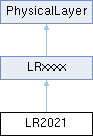
Public Types | |
| enum | OpMode_t { MODE_END_OF_TABLE = Module::MODE_END_OF_TABLE , MODE_STBY = Module::MODE_IDLE , MODE_RX = Module::MODE_RX , MODE_TX = Module::MODE_TX , MODE_RX_HF , MODE_TX_HF } |
| Custom operation modes for LR2021. Needed because LR2021 has several modems (sub-GHz, 2.4 GHz etc.) in one package. More... | |
Public Member Functions | |
| LR2021 (Module *mod) | |
| Default constructor. | |
| int16_t | begin (const ConfigLoRa_t &config) |
| Initialization method for LoRa modem. | |
| int16_t | begin (float freq=434.0, float bw=125.0, uint8_t sf=9, uint8_t cr=7, uint8_t syncWord=RADIOLIB_LR2021_LORA_SYNC_WORD_PRIVATE, int8_t power=10, uint16_t preambleLength=8, float tcxoVoltage=1.6) |
| Initialization method for LoRa modem. | |
| int16_t | beginGFSK (const ConfigFSK_t &config) |
| Initialization method for FSK modem. | |
| int16_t | beginGFSK (float freq=434.0, float br=4.8, float freqDev=5.0, float rxBw=153.8, int8_t power=10, uint16_t preambleLength=16, float tcxoVoltage=1.6) |
| Initialization method for FSK modem. | |
| int16_t | beginOOK (const ConfigOOK_t &config) |
| Initialization method for OOK modem. | |
| int16_t | beginOOK (float freq=434.0, float br=4.8, float rxBw=153.8, int8_t power=10, uint16_t preambleLength=16, float tcxoVoltage=1.6) |
| Initialization method for OOK modem. | |
| int16_t | beginLRFHSS (const ConfigLRFHSS_t &config) |
| Initialization method for LR-FHSS modem. | |
| int16_t | beginLRFHSS (float freq=434.0, uint8_t bw=RADIOLIB_LRXXXX_LR_FHSS_BW_722_66, uint8_t cr=RADIOLIB_LRXXXX_LR_FHSS_CR_2_3, bool narrowGrid=true, int8_t power=10, float tcxoVoltage=1.6) |
| Initialization method for LR-FHSS modem. | |
| int16_t | beginFLRC (const ConfigFLRC_t &config) |
| Initialization method for FLRC modem. | |
| int16_t | beginFLRC (float freq=434.0, uint16_t br=650, uint8_t cr=RADIOLIB_LR2021_FLRC_CR_2_3, int8_t pwr=10, uint16_t preambleLength=16, uint8_t dataShaping=RADIOLIB_SHAPING_0_5, float tcxoVoltage=1.6) |
| Initialization method for FLRC modem. | |
| int16_t | transmit (const uint8_t *data, size_t len, uint8_t addr=0) override |
| Blocking binary transmit method. Overloads for string-based transmissions are implemented in PhysicalLayer. | |
| int16_t | receive (uint8_t *data, size_t len, RadioLibTime_t timeout=0) override |
| Blocking binary receive method. Overloads for string-based transmissions are implemented in PhysicalLayer. | |
| int16_t | transmitDirect (uint32_t frf=0) override |
| Starts direct mode transmission. | |
| int16_t | receiveDirect () override |
| Starts direct mode reception. Only implemented for PhysicalLayer compatibility, as LR2021 does not support direct mode reception. Will always return RADIOLIB_ERR_UNKNOWN. | |
| int16_t | scanChannel () override |
| Performs scan for LoRa transmission in the current channel. Detects both preamble and payload. | |
| int16_t | scanChannel (const ChannelScanConfig_t &config) override |
| Performs scan for LoRa transmission in the current channel. Detects both preamble and payload. | |
| int16_t | standby () override |
| Sets the module to standby mode (overload for PhysicalLayer compatibility). Uses 13 MHz RC oscillator by default, or external oscillator if standbyXOSC is set to true. | |
| int16_t | standby (uint8_t mode) override |
| Sets the module to standby mode. | |
| int16_t | standby (uint8_t mode, bool wakeup) |
| Sets the module to standby mode. | |
| int16_t | sleep () override |
| Sets the module to sleep mode. To wake the device up, call standby(). Overload with warm start enabled for PhysicalLayer compatibility. | |
| int16_t | sleep (bool retainConfig, uint32_t sleepTime) |
| Sets the module to sleep mode. To wake the device up, call standby(). | |
| size_t | getPacketLength (bool update=true) override |
| Query modem for the packet length of received payload. | |
| int16_t | finishTransmit () override |
| Clean up after transmission is done. | |
| int16_t | startReceive () override |
| Interrupt-driven receive method with default parameters. Implemented for compatibility with PhysicalLayer. | |
| int16_t | startReceiveDutyCycle (uint32_t rxPeriod, uint32_t sleepPeriod, RadioLibIrqFlags_t irqFlags=RADIOLIB_IRQ_RX_DEFAULT_FLAGS, RadioLibIrqFlags_t irqMask=RADIOLIB_IRQ_RX_DEFAULT_MASK) |
| Interrupt-driven receive method where the device mostly sleeps and periodically wakes to listen. Note that this function assumes the unit will take 500us + TCXO_delay to change state. See datasheet section 13.1.7, version 1.2. | |
| int16_t | startReceiveDutyCycleAuto (uint16_t senderPreambleLength=0, uint16_t minSymbols=0, RadioLibIrqFlags_t irqFlags=RADIOLIB_IRQ_RX_DEFAULT_FLAGS, RadioLibIrqFlags_t irqMask=RADIOLIB_IRQ_RX_DEFAULT_MASK) |
| Calls startReceiveDutyCycle with rxPeriod and sleepPeriod set so the unit shouldn't miss any messages. | |
| int16_t | readData (uint8_t *data, size_t len) override |
| Reads data received after calling startReceive method. When the packet length is not known in advance, getPacketLength method must be called BEFORE calling readData! | |
| int16_t | finishReceive () override |
| Clean up after reception is done. | |
| int16_t | startChannelScan () override |
| Interrupt-driven channel activity detection method. IRQ1 will be activated when LoRa preamble is detected, or upon timeout. Defaults to CAD parameter values recommended by AN1200.48. | |
| int16_t | startChannelScan (const ChannelScanConfig_t &cfg) override |
| Interrupt-driven channel activity detection method. IRQ pin will be activated when LoRa preamble is detected, or upon timeout. | |
| int16_t | getChannelScanResult () override |
| Read the channel scan result. | |
| uint32_t | getIrqFlags () override |
| Read currently active IRQ flags. | |
| int16_t | setIrqFlags (uint32_t irq) override |
| Set interrupt on DIO1 to be sent on a specific IRQ bit (e.g. RxTimeout, CadDone). | |
| int16_t | clearIrqFlags (uint32_t irq) override |
| Clear interrupt on a specific IRQ bit (e.g. RxTimeout, CadDone). | |
| int16_t | setModem (ModemType_t modem) override |
| Set modem for the radio to use. Will perform full reset and reconfigure the radio using its default parameters. | |
| int16_t | setFrequency (float freq) override |
| Sets carrier frequency. Allowed values are in range from 150.0 to 960.0 MHz, 1900 - 2200 MHz and 2400 - 2500 MHz. Will automatically perform image calibration if the frequency changes by more than RADIOLIB_LR2021_CAL_IMG_FREQ_TRIG MHz. NOTE: When switching between sub-GHz and high-frequency bands, after changing the frequency, setOutputPower() must be called in order to set the correct power amplifier! | |
| int16_t | setFrequency (float freq, bool skipCalibration) |
| Sets carrier frequency. Allowed values are in range from 150.0 to 960.0 MHz, 1900 - 2200 MHz and 2400 - 2500 MHz. Will automatically perform image calibration if the frequency changes by more than RADIOLIB_LR2021_CAL_IMG_FREQ_TRIG MHz. NOTE: When switching between sub-GHz and high-frequency bands, after changing the frequency, setOutputPower() must be called in order to set the correct power amplifier! | |
| int16_t | setOutputPower (int8_t power) override |
| Sets output power. Allowed values are in range from -9 to 22 dBm (sub-GHz PA) or -19 to 12 dBm (high-frequency PA). | |
| int16_t | setOutputPower (int8_t power, uint32_t rampTimeUs) |
| Sets output power. Allowed values are in range from -9 to 22 dBm (sub-GHz PA) or -19 to 12 dBm (high-frequency PA). | |
| void | setPaTable (LR2021PaTableEntry_t *table, bool highFreq) |
| Sets custom PA configuration table. | |
| int16_t | setStandbyXOSC (bool enable) |
| Set standby mode to be used. XOSC standby uses more power, but allows faster switching between Rx and Tx modes. | |
| int16_t | checkOutputPower (int8_t power, int8_t *clipped) override |
| Check if output power is configurable. This method is needed for compatibility with PhysicalLayer::checkOutputPower. | |
| void | setRfSwitchTable (const uint32_t(&pins)[Module::RFSWITCH_MAX_PINS], const Module::RfSwitchMode_t table[]) |
| Some modules contain external RF switch controlled by pins. This function gives RadioLib control over those pins to automatically switch between various modes. | |
| int16_t | forceLDRO (bool enable) |
| Forces LoRa low data rate optimization. Only available in LoRa mode. After calling this method, LDRO will always be set to the provided value, regardless of symbol length. To re-enable automatic LDRO configuration, call LR2021::autoLDRO(). | |
| int16_t | autoLDRO () |
| Re-enables automatic LDRO configuration. Only available in LoRa mode. After calling this method, LDRO will be enabled automatically when symbol length exceeds 16 ms, or in cases when SX128x LoRa bandwidths are used with SF > 10. | |
| int16_t | setBandwidth (float bw) |
| Sets LoRa bandwidth. Allowed values are 31.25, 41.67, 62.5, 83.34, 125.0, 101.56, 203.13, 250.0, 406.25, 500.0 kHz, 812.5 kHz and 1000.0 kHz. | |
| int16_t | setSpreadingFactor (uint8_t sf, bool legacy=false) |
| Sets LoRa spreading factor. Allowed values range from 5 to 12. | |
| int16_t | setCodingRate (uint8_t cr, bool longInterleave=false) |
| Sets LoRa coding rate denominator. Allowed values range from 4 to 8. Note that a value of 4 means no coding, is undocumented and not recommended without your own FEC. | |
| int16_t | setSyncWord (uint8_t syncWord) |
| Sets LoRa sync word. | |
| int16_t | setPreambleLength (size_t preambleLength) override |
| Sets preamble length for LoRa or GFSK modem. Allowed values range from 1 to 65535. | |
| int16_t | setTCXO (float voltage, uint32_t delay=1000000) |
| Sets TCXO (Temperature Compensated Crystal Oscillator) configuration. | |
| int16_t | setCRC (uint8_t len, uint32_t initial=0x00001D0FUL, uint32_t polynomial=0x00001021UL, bool inverted=true) |
| Sets CRC configuration. | |
| int16_t | invertIQ (bool enable) override |
| Enable/disable inversion of the I and Q signals. | |
| int16_t | setBitRate (float br) override |
| Sets GFSK bit rate. Allowed values range from 0.5 to 2000.0 kbps. | |
| int16_t | setFrequencyDeviation (float freqDev) override |
| Sets GFSK frequency deviation. Allowed values range from 0.6 to 500.0 kHz. | |
| int16_t | setRxBandwidth (float rxBw) |
| Sets GFSK receiver bandwidth. Allowed values are 4.8, 5.8, 7.3, 9.7, 11.7, 14.6, 19.5, 23.4, 29.3, 39.0, 46.9, 58.6, 78.2, 93.8, 117.3, 156.2, 187.2, 234.3, 312.0, 373.6 and 467.0 kHz. | |
| int16_t | setSyncWord (uint8_t *syncWord, size_t len) override |
| Sets GFSK sync word in the form of array of up to 8 bytes. | |
| int16_t | setNodeAddress (uint8_t nodeAddr) |
| Sets node address. Calling this method will also enable address filtering for node address only. | |
| int16_t | setBroadcastAddress (uint8_t broadAddr) |
| Sets broadcast address. Calling this method will also enable address filtering for node and broadcast address. | |
| int16_t | disableAddressFiltering () |
| Disables address filtering. Calling this method will also erase previously set addresses. | |
| int16_t | setDataShaping (uint8_t sh) override |
| Sets time-bandwidth product of Gaussian filter applied for shaping. Allowed values are RADIOLIB_SHAPING_0_3, RADIOLIB_SHAPING_0_5, RADIOLIB_SHAPING_0_7 or RADIOLIB_SHAPING_1_0. Set to RADIOLIB_SHAPING_NONE to disable data shaping. | |
| int16_t | setEncoding (uint8_t encoding) override |
| Sets transmission encoding. Available in GFSK mode only. Serves only as alias for PhysicalLayer compatibility. | |
| int16_t | fixedPacketLengthMode (uint8_t len=RADIOLIB_LR2021_MAX_PACKET_LENGTH) |
| Set modem in fixed packet length mode. Available in GFSK mode only. | |
| int16_t | variablePacketLengthMode (uint8_t maxLen=RADIOLIB_LR2021_MAX_PACKET_LENGTH) |
| Set modem in variable packet length mode. Available in GFSK mode only. | |
| int16_t | setWhitening (bool enabled, uint16_t initial=0x01FF) |
| Sets GFSK whitening parameters. | |
| int16_t | setDataRate (DataRate_t dr, ModemType_t modem=RADIOLIB_MODEM_NONE) override |
| Set data rate. | |
| int16_t | checkDataRate (DataRate_t dr, ModemType_t modem=RADIOLIB_MODEM_NONE) override |
| Check the data rate can be configured by this module. | |
| int16_t | setLrFhssConfig (uint8_t bw, uint8_t cr, uint8_t hdrCount=3, uint16_t hopSeed=0x13A) |
| Sets LR-FHSS configuration. | |
| int16_t | setRxBoostedGainMode (uint8_t level) |
| Enables or disables Rx Boosted Gain mode (additional Rx gain for increased power consumption). | |
| RadioLibTime_t | getTimeOnAir (size_t len) override |
| Get expected time-on-air for a given size of payload. | |
| int16_t | getModem (ModemType_t *modem) override |
| Get modem currently in use by the radio. | |
| int16_t | getMode (RadioModeType_t *mode) override |
| Read the operating mode the radio is in, as the chip reports it. Unlike PhysicalLayer::stagedMode, which is what was last asked of the radio, this reads the hardware, so a caller can tell a radio that has left a mode on its own - a receive that did not survive a frame, or a chip that lost its state - from one that is still in it. | |
| int16_t | stageMode (RadioModeType_t mode, RadioModeConfig_t *cfg) override |
| Stage mode of the radio to be launched later using launchMode. | |
| int16_t | launchMode () override |
| Launch previously staged mode. | |
| int16_t | writeTxBuffer (const uint8_t *data, size_t len) override |
| Write a payload into the transmit buffer without staging or starting a transmission. This allows the payload write, which is the slowest part of starting a transmission, to be done while the radio is busy with something else - during a channel scan, for example. The transmission is staged afterwards by calling stageMode with RADIOLIB_RADIO_MODE_TX and RadioModeConfig_t::transmit.data set to NULL, which sets the packet parameters and the IRQ mapping for the payload already in the buffer; transmit.len must still be set to its length. The buffer holds exactly this payload after the call, whether or not one was written before. | |
| int16_t | clearTxBuffer () override |
| Discard a payload previously written by writeTxBuffer. On radios whose transmit buffer is simply overwritten by the next write there is nothing to discard, and this reports success without touching the radio. | |
| float | getVoltage (uint8_t bits=13) |
| Read the supply voltage on the Vbat pin. | |
| float | getTemperature (uint8_t source, uint8_t bits=13) |
| Read the temperature. | |
| float | getRSSI () override |
| Gets received signal strength indicator. Overload with packet mode enabled for PhysicalLayer compatibility. | |
| float | getRSSI (bool packet, bool skipReceive=false) |
| Gets RSSI (Received Signal Strength Indicator). | |
| float | getSNR () override |
| Gets SNR (Signal to Noise Ratio) of the last received packet. Only available for LoRa modem. | |
| uint8_t | randomByte () override |
| Get one truly random byte from RSSI noise. | |
| int16_t | implicitHeader (size_t len) |
| Set implicit header mode for future reception/transmission. | |
| int16_t | explicitHeader () |
| Set explicit header mode for future reception/transmission. | |
| int16_t | ookDetector (uint16_t pattern=0x0285, uint8_t len=16, uint8_t repeats=0, bool syncRaw=false, bool rising=false, uint8_t sofLen=0) |
| Set OOK detector properties. The default values are set to allow ADS-B reception. | |
| int16_t | setOokDetectionThreshold (int16_t level) |
| Set OOK detection threshold. | |
| int16_t | setSideDetector (const LR2021LoRaSideDetector_t *cfg, size_t numDetectors) |
| Configure LoRa side detector, which enables to detect mutiple spreading factors and receive one of them. The following limitations apply: In Rx mode, all side-detector spreading factors must be higher than the primary one (configured via begin or setSpreadingFactor) For CAD mode, the above condition is inverted - all side-detector spreading factors must be smaller All packets to be detected must have the same header type (implicit or explicit) If bandwidth is higher than 500 kHz, at most 2 side detectors are allowed. If the primary spreading factor is 10, 11 or 12, at most 2 side detectors are allowed. All spreading factors must be different. The difference between maximum and minimum spreading factor used must be less than or equal to 4. | |
| int16_t | setGain (uint8_t gain) |
| Sets gain of receiver LNA (low-noise amplifier). Can be set to any integer in range 1 to 13, where 13 is the highest gain. Set to 0 to enable automatic gain control (recommended). | |
| int16_t | getLoRaPacketStatus (uint8_t *cr, bool *crc, uint8_t *packetLen=NULL, float *snrPacket=NULL, float *rssiPacket=NULL, float *rssiSignalPacket=NULL, uint8_t *detector=NULL) |
| Read status of the last received packet. Each parameter can be set to NULL if the caller is not intending to process it. | |
| int16_t | getLoRaRxHeaderInfo (uint8_t *cr, bool *hasCRC) |
| Get LoRa header information from last received packet. Implementation based on getLoRaPacketStatus. | |
| int16_t | getErrors (uint16_t *err) |
| Get internal error bits. | |
| int16_t | getLoRaRxStats (uint16_t *pktRxTotal, uint16_t *pktCrcError, uint16_t *headerCrcError, uint16_t *falseSynch) |
| Get LoRa Rx statistics. | |
| int16_t | getRangingStats (uint16_t *exchangeValid, uint16_t *requestValid, uint16_t *responseDone, uint16_t *timeout, uint16_t *requestDiscarded) |
| Get ranging Rx statistics. | |
| int16_t | getGfskRxStats (uint16_t *packetRx, uint16_t *packetCrcError, uint16_t *lenError, uint16_t *preambleDet, uint16_t *syncOk, uint16_t *syncFail, uint16_t *timeout) |
| Get GFSK Rx statistics. | |
| int16_t | getOqpskRxStats (uint16_t *packetRx, uint16_t *crcError, uint16_t *lenError) |
| Get OQPSK Rx statistics. | |
| int16_t | getFlrcRxStats (uint16_t *packetRx, uint16_t *packetCrcError, uint16_t *lenError) |
| Get FLRC Rx statistics. | |
| int16_t | getOokRxStats (uint16_t *packetRx, uint16_t *crcError, uint16_t *lenError) |
| Get OOK Rx statistics. | |
| int16_t | setRegulatorLDO () |
| Set regulator mode to LDO. | |
| int16_t | setRegulatorDCDC () |
| Set regulator mode to DC-DC. | |
| int16_t | transmit (const char *str, uint8_t addr=0) |
| C-string transmit method. | |
| int16_t | startTransmit (const char *str, uint8_t addr=0) |
| Interrupt-driven Arduino String transmit method. Unlike the standard transmit method, this one is non-blocking. Interrupt pin will be activated when transmission finishes. | |
| virtual int16_t | startTransmit (const uint8_t *data, size_t len, uint8_t addr=0) |
| Interrupt-driven binary transmit method. | |
| virtual int16_t | startReceive (uint32_t timeout, RadioLibIrqFlags_t irqFlags=RADIOLIB_IRQ_RX_DEFAULT_FLAGS, RadioLibIrqFlags_t irqMask=RADIOLIB_IRQ_RX_DEFAULT_MASK, size_t len=0) |
| Interrupt-driven receive method. A DIO pin will be activated when full packet is received. Must be implemented in module class. | |
| Public Member Functions inherited from LRxxxx | |
| LRxxxx (Module *mod) | |
| int16_t | reset () |
| Reset method. Will reset the chip to the default state using RST pin. | |
| void | setPacketReceivedAction (void(*func)(void)) override |
| Sets interrupt service routine to call when a packet is received. | |
| void | clearPacketReceivedAction () override |
| Clears interrupt service routine to call when a packet is received. | |
| void | setPacketSentAction (void(*func)(void)) override |
| Sets interrupt service routine to call when a packet is sent. | |
| void | clearPacketSentAction () override |
| Clears interrupt service routine to call when a packet is sent. | |
| uint32_t | getIrqStatus () |
| Reads the current IRQ status. | |
| RadioLibTime_t | calculateTimeOnAir (ModemType_t modem, DataRate_t dr, PacketConfig_t pc, size_t len) override |
| Calculate the expected time-on-air for a given modem, data rate, packet configuration and payload size. | |
| RadioLibTime_t | calculateRxTimeout (RadioLibTime_t timeoutUs) override |
| Calculate the timeout value for this specific module / series (in number of symbols or units of time). | |
| Public Member Functions inherited from PhysicalLayer | |
| PhysicalLayer () | |
| Default constructor. | |
| virtual | ~PhysicalLayer ()=default |
| Default destructor. | |
| int16_t | transmit (const char *str, uint8_t addr=0) |
| C-string transmit method. | |
| int16_t | startTransmit (const char *str, uint8_t addr=0) |
| Interrupt-driven Arduino String transmit method. Unlike the standard transmit method, this one is non-blocking. Interrupt pin will be activated when transmission finishes. | |
| uint32_t | getIrqMapped (RadioLibIrqFlags_t irq) |
| Convert from radio-agnostic IRQ flags to radio-specific flags. | |
| int16_t | checkIrq (RadioLibIrqType_t irq) |
| Check whether a specific IRQ bit is set (e.g. RxTimeout, CadDone). | |
| int16_t | setIrq (RadioLibIrqFlags_t irq) |
| Set interrupt on specific IRQ bit(s) (e.g. RxTimeout, CadDone). Keep in mind that not all radio modules support all RADIOLIB_IRQ_ flags! | |
| int16_t | clearIrq (RadioLibIrqFlags_t irq) |
| Clear interrupt on a specific IRQ bit (e.g. RxTimeout, CadDone). Keep in mind that not all radio modules support all RADIOLIB_IRQ_ flags! | |
| int32_t | random (int32_t max) |
| Get truly random number in range 0 - max. | |
| int32_t | random (int32_t min, int32_t max) |
| Get truly random number in range min - max. | |
| int16_t | startDirect () |
| Configure module parameters for direct modes. Must be called prior to "ham" modes like RTTY or AX.25. Only available in FSK mode. | |
| int16_t | setDirectSyncWord (uint32_t syncWord, uint8_t len) |
| Set sync word to be used to determine start of packet in direct reception mode. | |
| virtual void | setDirectAction (void(*func)(void)) |
| Set interrupt service routine function to call when data bit is received in direct mode. Must be implemented in module class. | |
| virtual void | readBit (uint32_t pin) |
| Function to read and process data bit in direct reception mode. Must be implemented in module class. | |
| int16_t | available () |
| Get the number of direct mode bytes currently available in buffer. | |
| void | dropSync () |
| Forcefully drop synchronization. | |
| uint8_t | read (bool drop=true) |
| Get data from direct mode buffer. | |
| virtual void | setIrqAction (void(*func)(void), bool rising=true) |
| Sets interrupt service routine to call when IRQ is activated. | |
| virtual void | clearIrqAction () |
| Clears interrupt service routine to call when IRQ is activated. | |
| virtual void | setChannelScanAction (void(*func)(void)) |
| Sets interrupt service routine to call when a channel scan is finished. | |
| virtual void | clearChannelScanAction () |
| Clears interrupt service routine to call when a channel scan is finished. | |
| int16_t | calculateRxDutyCycle (size_t txPreLen, size_t rxPreLen, uint16_t minSymbols, DataRate_t *dr, uint32_t *wakePeriod, uint32_t *sleepPeriod) |
| Calculates sleep and wake cycles for startReceiveDutyCycle methods so that the receiver should not miss any messages. Useful only for LoRa modems. | |
Public Attributes | |
| uint32_t | irqDioNum = 5 |
| Which DIO pin is to be used as the interrupt pin. | |
| bool | fastCad = false |
| Determines the type of Lora CAD to perform, either "standard" CAD (same as is implemented LR11x0, SX126x and others), or a "fast" CAD if set to true. If there is no signal to be detected, fast CAD should return faster than standard CAD. | |
| float | tcxoVoltage = 1.6 |
| TCXO reference voltage to be set on DIO3. Defaults to 1.6 V. If you are seeing -706/-707 error codes, it likely means you are using non-0 value for module with XTAL. To use XTAL, set this value to 0. | |
| Public Attributes inherited from PhysicalLayer | |
| float | freqStep |
| Frequency step of the synthesizer in Hz. | |
| size_t | maxPacketLength |
| Maximum length of packet that can be received by the module. | |
| bool | resetOnStartup = true |
| Whether to reset the module on startup. Setting to false allows to restore radio operation by calling begin after deep sleep mode on some platforms (like ESP32). | |
Member Enumeration Documentation
◆ OpMode_t
| enum LR2021::OpMode_t |
Custom operation modes for LR2021. Needed because LR2021 has several modems (sub-GHz, 2.4 GHz etc.) in one package.
Constructor & Destructor Documentation
◆ LR2021()
| LR2021::LR2021 | ( | Module * | mod | ) |
Default constructor.
- Parameters
-
mod Instance of Module that will be used to communicate with the radio.
Member Function Documentation
◆ autoLDRO()
| int16_t LR2021::autoLDRO | ( | ) |
Re-enables automatic LDRO configuration. Only available in LoRa mode. After calling this method, LDRO will be enabled automatically when symbol length exceeds 16 ms, or in cases when SX128x LoRa bandwidths are used with SF > 10.
- Returns
- Status Codes
◆ begin() [1/2]
| int16_t LR2021::begin | ( | const ConfigLoRa_t & | config | ) |
Initialization method for LoRa modem.
This method initializes the LoRa modem with the specified configuration. Supports designated initializers when using C++14 or above.
- Parameters
-
config Initialization configuration.
- Returns
- Status Codes
◆ begin() [2/2]
| int16_t LR2021::begin | ( | float | freq = 434.0, |
| float | bw = 125.0, | ||
| uint8_t | sf = 9, | ||
| uint8_t | cr = 7, | ||
| uint8_t | syncWord = RADIOLIB_LR2021_LORA_SYNC_WORD_PRIVATE, | ||
| int8_t | power = 10, | ||
| uint16_t | preambleLength = 8, | ||
| float | tcxoVoltage = 1.6 ) |
Initialization method for LoRa modem.
- Deprecated
- Use begin(const ConfigLoRa_t& config) instead.
- Parameters
-
freq Carrier frequency in MHz. Defaults to 434.0 MHz. bw LoRa bandwidth in kHz. Defaults to 125.0 kHz. sf LoRa spreading factor. Defaults to 9. cr LoRa coding rate denominator. Defaults to 7 (coding rate 4/7). Allowed values range from 4 to 8. Note that a value of 4 means no coding, is undocumented and not recommended without your own FEC. syncWord 1-byte LoRa sync word. Defaults to RADIOLIB_LR2021_LORA_SYNC_WORD_PRIVATE (0x12). power Output power in dBm. Defaults to 10 dBm. preambleLength LoRa preamble length in symbols. Defaults to 8 symbols. tcxoVoltage TCXO reference voltage to be set. Defaults to 1.6 V. If you are seeing -706/-707 error codes, it likely means you are using non-0 value for module with XTAL. To use XTAL, either set this value to 0, or set LR2021::XTAL to true.
- Returns
- Status Codes
◆ beginFLRC() [1/2]
| int16_t LR2021::beginFLRC | ( | const ConfigFLRC_t & | config | ) |
Initialization method for FLRC modem.
This method initializes the LoRa modem with the specified configuration. Supports designated initializers when using C++14 or above.
- Parameters
-
config Initialization configuration.
- Returns
- Status Codes
◆ beginFLRC() [2/2]
| int16_t LR2021::beginFLRC | ( | float | freq = 434.0, |
| uint16_t | br = 650, | ||
| uint8_t | cr = RADIOLIB_LR2021_FLRC_CR_2_3, | ||
| int8_t | pwr = 10, | ||
| uint16_t | preambleLength = 16, | ||
| uint8_t | dataShaping = RADIOLIB_SHAPING_0_5, | ||
| float | tcxoVoltage = 1.6 ) |
Initialization method for FLRC modem.
- Deprecated
- Use begin(const ConfigFLRC_t& config) instead.
- Parameters
-
freq Carrier frequency in MHz. Defaults to 434.0 MHz. br FLRC bit rate in kbps. Defaults to 650 kbps. cr FLRC coding rate. Defaults to RADIOLIB_LR2021_FLRC_CR_2_3 (coding rate 2/3). pwr Output power in dBm. Defaults to 10 dBm. preambleLength FLRC preamble length in bits. Defaults to 16 bits. dataShaping Time-bandwidth product of the Gaussian filter to be used for shaping. Defaults to 0.5. tcxoVoltage TCXO reference voltage to be set. Defaults to 1.6 V. If you are seeing -706/-707 error codes, it likely means you are using non-0 value for module with XTAL. To use XTAL, either set this value to 0, or set LR2021::XTAL to true.
- Returns
- Status Codes
◆ beginGFSK() [1/2]
| int16_t LR2021::beginGFSK | ( | const ConfigFSK_t & | config | ) |
Initialization method for FSK modem.
This method initializes the LoRa modem with the specified configuration. Supports designated initializers when using C++14 or above.
- Parameters
-
config Initialization configuration.
- Returns
- Status Codes
◆ beginGFSK() [2/2]
| int16_t LR2021::beginGFSK | ( | float | freq = 434.0, |
| float | br = 4.8, | ||
| float | freqDev = 5.0, | ||
| float | rxBw = 153.8, | ||
| int8_t | power = 10, | ||
| uint16_t | preambleLength = 16, | ||
| float | tcxoVoltage = 1.6 ) |
Initialization method for FSK modem.
- Deprecated
- Use begin(const ConfigFSK_t& config) instead.
- Parameters
-
freq Carrier frequency in MHz. Defaults to 434.0 MHz. br FSK bit rate in kbps. Defaults to 4.8 kbps. freqDev Frequency deviation from carrier frequency in kHz. Defaults to 5.0 kHz. rxBw Receiver bandwidth in kHz. Defaults to 153.8 kHz. power Output power in dBm. Defaults to 10 dBm. preambleLength FSK preamble length in bits. Defaults to 16 bits. tcxoVoltage TCXO reference voltage to be set. Defaults to 1.6 V. If you are seeing -706/-707 error codes, it likely means you are using non-0 value for module with XTAL. To use XTAL, either set this value to 0, or set LR2021::XTAL to true.
- Returns
- Status Codes
◆ beginLRFHSS() [1/2]
| int16_t LR2021::beginLRFHSS | ( | const ConfigLRFHSS_t & | config | ) |
Initialization method for LR-FHSS modem.
This method initializes the LoRa modem with the specified configuration. Supports designated initializers when using C++14 or above.
- Parameters
-
config Initialization configuration.
- Returns
- Status Codes
◆ beginLRFHSS() [2/2]
| int16_t LR2021::beginLRFHSS | ( | float | freq = 434.0, |
| uint8_t | bw = RADIOLIB_LRXXXX_LR_FHSS_BW_722_66, | ||
| uint8_t | cr = RADIOLIB_LRXXXX_LR_FHSS_CR_2_3, | ||
| bool | narrowGrid = true, | ||
| int8_t | power = 10, | ||
| float | tcxoVoltage = 1.6 ) |
Initialization method for LR-FHSS modem.
- Deprecated
- Use begin(const ConfigLRFHSS_t& config) instead.
- Parameters
-
freq Carrier frequency in MHz. Defaults to 434.0 MHz. bw LR-FHSS bandwidth, one of RADIOLIB_LRXXXX_LR_FHSS_BW_* values. Defaults to 722.66 kHz. cr LR-FHSS coding rate, one of RADIOLIB_LRXXXX_LR_FHSS_CR_* values. Defaults to 2/3 coding rate. narrowGrid Whether to use narrow (3.9 kHz) or wide (25.39 kHz) grid spacing. Defaults to true (narrow/non-FCC) grid. power Output power in dBm. Defaults to 10 dBm. tcxoVoltage TCXO reference voltage to be set. Defaults to 1.6 V. If you are seeing -706/-707 error codes, it likely means you are using non-0 value for module with XTAL. To use XTAL, either set this value to 0, or set LR2021::XTAL to true.
- Returns
- Status Codes
◆ beginOOK() [1/2]
| int16_t LR2021::beginOOK | ( | const ConfigOOK_t & | config | ) |
Initialization method for OOK modem.
This method initializes the LoRa modem with the specified configuration. Supports designated initializers when using C++14 or above.
- Parameters
-
config Initialization configuration.
- Returns
- Status Codes
◆ beginOOK() [2/2]
| int16_t LR2021::beginOOK | ( | float | freq = 434.0, |
| float | br = 4.8, | ||
| float | rxBw = 153.8, | ||
| int8_t | power = 10, | ||
| uint16_t | preambleLength = 16, | ||
| float | tcxoVoltage = 1.6 ) |
Initialization method for OOK modem.
- Deprecated
- Use begin(const ConfigOOK_t& config) instead.
- Parameters
-
freq Carrier frequency in MHz. Defaults to 434.0 MHz. br OOK bit rate in kbps. Defaults to 4.8 kbps. rxBw Receiver bandwidth in kHz. Defaults to 153.8 kHz. power Output power in dBm. Defaults to 10 dBm. preambleLength OOK preamble length in bits. Defaults to 16 bits. tcxoVoltage TCXO reference voltage to be set. Defaults to 1.6 V. If you are seeing -706/-707 error codes, it likely means you are using non-0 value for module with XTAL. To use XTAL, either set this value to 0, or set LR2021::XTAL to true.
- Returns
- Status Codes
◆ checkDataRate()
|
overridevirtual |
Check the data rate can be configured by this module.
- Parameters
-
dr Data rate struct. modem The modem corresponding to the requested datarate (FSK, LoRa or LR-FHSS). Defaults to currently active modem if not supplied.
- Returns
- Status Codes
Reimplemented from PhysicalLayer.
◆ checkOutputPower()
|
overridevirtual |
Check if output power is configurable. This method is needed for compatibility with PhysicalLayer::checkOutputPower.
- Parameters
-
power Output power in dBm, PA will be determined automatically. clipped Clipped output power value to what is possible within the module's range.
- Returns
- Status Codes
Reimplemented from PhysicalLayer.
◆ clearIrqFlags()
|
overridevirtual |
Clear interrupt on a specific IRQ bit (e.g. RxTimeout, CadDone).
- Parameters
-
irq Module-specific IRQ flags.
- Returns
- Status Codes
Reimplemented from PhysicalLayer.
◆ clearTxBuffer()
|
overridevirtual |
Discard a payload previously written by writeTxBuffer. On radios whose transmit buffer is simply overwritten by the next write there is nothing to discard, and this reports success without touching the radio.
- Returns
- Status Codes
Reimplemented from PhysicalLayer.
◆ disableAddressFiltering()
| int16_t LR2021::disableAddressFiltering | ( | ) |
Disables address filtering. Calling this method will also erase previously set addresses.
- Returns
- Status Codes
◆ explicitHeader()
| int16_t LR2021::explicitHeader | ( | ) |
Set explicit header mode for future reception/transmission.
- Returns
- Status Codes
◆ finishReceive()
|
overridevirtual |
◆ finishTransmit()
|
overridevirtual |
◆ fixedPacketLengthMode()
| int16_t LR2021::fixedPacketLengthMode | ( | uint8_t | len = RADIOLIB_LR2021_MAX_PACKET_LENGTH | ) |
Set modem in fixed packet length mode. Available in GFSK mode only.
- Parameters
-
len Packet length.
- Returns
- Status Codes
◆ forceLDRO()
| int16_t LR2021::forceLDRO | ( | bool | enable | ) |
Forces LoRa low data rate optimization. Only available in LoRa mode. After calling this method, LDRO will always be set to the provided value, regardless of symbol length. To re-enable automatic LDRO configuration, call LR2021::autoLDRO().
- Parameters
-
enable Force LDRO to be always enabled (true) or disabled (false).
- Returns
- Status Codes
◆ getChannelScanResult()
|
overridevirtual |
◆ getErrors()
| int16_t LR2021::getErrors | ( | uint16_t * | err | ) |
Get internal error bits.
- Parameters
-
err Pointer to variable to store the error bits.
- Returns
- Status Codes
◆ getFlrcRxStats()
| int16_t LR2021::getFlrcRxStats | ( | uint16_t * | packetRx, |
| uint16_t * | packetCrcError, | ||
| uint16_t * | lenError ) |
Get FLRC Rx statistics.
- Parameters
-
packetRx number of received packets. packetCrcError Number of received packets with a CRC error. lenError Number of packets with a length error.
- Returns
- Status Codes
◆ getGfskRxStats()
| int16_t LR2021::getGfskRxStats | ( | uint16_t * | packetRx, |
| uint16_t * | packetCrcError, | ||
| uint16_t * | lenError, | ||
| uint16_t * | preambleDet, | ||
| uint16_t * | syncOk, | ||
| uint16_t * | syncFail, | ||
| uint16_t * | timeout ) |
Get GFSK Rx statistics.
- Parameters
-
packetRx number of received packets. packetCrcError Number of received packets with a CRC error. lenError Number of packets with a length error. preambleDet Number of detections. syncOk Number of correct found Syncwords. syncFail Number of failed Syncwords. timeout Number of RTC timeouts.
- Returns
- Status Codes
◆ getIrqFlags()
|
overridevirtual |
◆ getLoRaPacketStatus()
| int16_t LR2021::getLoRaPacketStatus | ( | uint8_t * | cr, |
| bool * | crc, | ||
| uint8_t * | packetLen = NULL, | ||
| float * | snrPacket = NULL, | ||
| float * | rssiPacket = NULL, | ||
| float * | rssiSignalPacket = NULL, | ||
| uint8_t * | detector = NULL ) |
Read status of the last received packet. Each parameter can be set to NULL if the caller is not intending to process it.
- Parameters
-
cr Coding rate of the last received packet crc Will be set to true if the last packet had a CRC, false otherwise packetLen Length of the last received packet in bytes snrPacket SNR of the last received packet in dB rssiPacket RSSI of the last received packet in dBm rssiSignalPacket Estimation of the RSSI of LoRa signal after despreading in dBm detector Index of the detector that received the packet: 0 = main, 1 = side 1, 2 = side 2, 3 = side 3
- Returns
- Status Codes
◆ getLoRaRxHeaderInfo()
| int16_t LR2021::getLoRaRxHeaderInfo | ( | uint8_t * | cr, |
| bool * | hasCRC ) |
Get LoRa header information from last received packet. Implementation based on getLoRaPacketStatus.
- Parameters
-
cr Pointer to variable to store the coding rate. hasCRC Pointer to variable to store the CRC status.
- Returns
- Status Codes
◆ getLoRaRxStats()
| int16_t LR2021::getLoRaRxStats | ( | uint16_t * | pktRxTotal, |
| uint16_t * | pktCrcError, | ||
| uint16_t * | headerCrcError, | ||
| uint16_t * | falseSynch ) |
Get LoRa Rx statistics.
- Parameters
-
pktRxTotal Total number of received packets. pktCrcError Number of received packets with a CRC error. headerCrcError Number of received packets with a header error. falseSynch Number of false synchronizations.
- Returns
- Status Codes
◆ getMode()
|
overridevirtual |
Read the operating mode the radio is in, as the chip reports it. Unlike PhysicalLayer::stagedMode, which is what was last asked of the radio, this reads the hardware, so a caller can tell a radio that has left a mode on its own - a receive that did not survive a frame, or a chip that lost its state - from one that is still in it.
- Parameters
-
mode Pointer to the variable to save the mode into. A mode the chip reports that has no RadioModeType_t equivalent, frequency synthesis for example, is reported as RADIOLIB_RADIO_MODE_NONE.
- Returns
- Status Codes
Reimplemented from PhysicalLayer.
◆ getModem()
|
overridevirtual |
Get modem currently in use by the radio.
- Parameters
-
modem Pointer to a variable to save the retrieved configuration into.
- Returns
- Status Codes
Reimplemented from PhysicalLayer.
◆ getOokRxStats()
| int16_t LR2021::getOokRxStats | ( | uint16_t * | packetRx, |
| uint16_t * | crcError, | ||
| uint16_t * | lenError ) |
Get OOK Rx statistics.
- Parameters
-
packetRx number of received packets. packetCrcError Number of received packets with a CRC error. lenError Number of packets with a length error.
- Returns
- Status Codes
◆ getOqpskRxStats()
| int16_t LR2021::getOqpskRxStats | ( | uint16_t * | packetRx, |
| uint16_t * | crcError, | ||
| uint16_t * | lenError ) |
Get OQPSK Rx statistics.
- Parameters
-
packetRx number of received packets. packetCrcError Number of received packets with a CRC error. lenError Number of packets with a length error.
- Returns
- Status Codes
◆ getPacketLength()
|
overridevirtual |
Query modem for the packet length of received payload.
- Parameters
-
update Update received packet length. Will return cached value when set to false.
- Returns
- Length of last received packet in bytes.
Reimplemented from PhysicalLayer.
◆ getRangingStats()
| int16_t LR2021::getRangingStats | ( | uint16_t * | exchangeValid, |
| uint16_t * | requestValid, | ||
| uint16_t * | responseDone, | ||
| uint16_t * | timeout, | ||
| uint16_t * | requestDiscarded ) |
Get ranging Rx statistics.
- Parameters
-
exchangeValid Number of valid ranging exchanges. requestValid Number of valid ranging requests done. responseDone Number of ranging responses done. timeout Number of ftimeout events that have occurred. requestDiscarded Number of discarded ranging requests.
- Returns
- Status Codes
◆ getRSSI() [1/2]
|
overridevirtual |
Gets received signal strength indicator. Overload with packet mode enabled for PhysicalLayer compatibility.
- Returns
- RSSI value in dBm.
Reimplemented from PhysicalLayer.
◆ getRSSI() [2/2]
| float LR2021::getRSSI | ( | bool | packet, |
| bool | skipReceive = false ) |
Gets RSSI (Received Signal Strength Indicator).
- Parameters
-
packet Whether to read last packet RSSI, or the current value. NOTE: With OOK modem, the "packet" RSSI value is the received power level of the high bits (digital 1). skipReceive Set to true to skip putting radio in receive mode for instantaneous RSSI measurement. If false, after the RSSI measurement, the radio will be in standby mode.
- Returns
- RSSI value in dBm.
◆ getSNR()
|
overridevirtual |
Gets SNR (Signal to Noise Ratio) of the last received packet. Only available for LoRa modem.
- Returns
- SNR of the last received packet in dB.
Reimplemented from PhysicalLayer.
◆ getTemperature()
| float LR2021::getTemperature | ( | uint8_t | source, |
| uint8_t | bits = 13 ) |
Read the temperature.
- Parameters
-
source Measurement source, one of RADIOLIB_LR2021_TEMP_SOURCE_* macros. bits Measurement resolution in bits, 8 to 13.
- Returns
- Temperature in degrees Celsius.
◆ getTimeOnAir()
|
overridevirtual |
Get expected time-on-air for a given size of payload.
- Parameters
-
len Payload length in bytes.
- Returns
- Expected time-on-air in microseconds.
Reimplemented from PhysicalLayer.
◆ getVoltage()
| float LR2021::getVoltage | ( | uint8_t | bits = 13 | ) |
Read the supply voltage on the Vbat pin.
- Parameters
-
bits Measurement resolution in bits, 8 to 13.
- Returns
- Supply voltage in volts.
◆ implicitHeader()
| int16_t LR2021::implicitHeader | ( | size_t | len | ) |
Set implicit header mode for future reception/transmission.
- Parameters
-
len Payload length in bytes.
- Returns
- Status Codes
◆ invertIQ()
|
overridevirtual |
Enable/disable inversion of the I and Q signals.
- Parameters
-
enable IQ inversion enabled (true) or disabled (false);
- Returns
- Status Codes
Reimplemented from PhysicalLayer.
◆ launchMode()
|
overridevirtual |
◆ ookDetector()
| int16_t LR2021::ookDetector | ( | uint16_t | pattern = 0x0285, |
| uint8_t | len = 16, | ||
| uint8_t | repeats = 0, | ||
| bool | syncRaw = false, | ||
| bool | rising = false, | ||
| uint8_t | sofLen = 0 ) |
Set OOK detector properties. The default values are set to allow ADS-B reception.
- Parameters
-
pattern Preamble pattern, should end with 01 or 10 (binary). len Preamble pattern length in bits. repeats Number of preamble repeats, maximum of 31. syncRaw Whether the sync word is send raw (unencoded) or encoded. Set to false for encoded sync word. rising Whether the start of frame delimiter edge is rising (true) or falling (false). sofLen Start-of-frame length in bits.
- Returns
- Status Codes
◆ randomByte()
|
overridevirtual |
◆ readData()
|
overridevirtual |
Reads data received after calling startReceive method. When the packet length is not known in advance, getPacketLength method must be called BEFORE calling readData!
- Parameters
-
data Pointer to array to save the received binary data. len Number of bytes that will be read. When set to 0, the packet length will be retrieved automatically. When more bytes than received are requested, only the number of bytes requested will be returned.
- Returns
- Status Codes
Reimplemented from PhysicalLayer.
◆ receive()
|
overridevirtual |
Blocking binary receive method. Overloads for string-based transmissions are implemented in PhysicalLayer.
- Parameters
-
data Pointer to array to save the received binary data. len Number of bytes that will be received. Must be known in advance for binary transmissions. timeout Reception timeout in milliseconds. If set to 0, timeout period will be calculated automatically based on the radio configuration.
- Returns
- Status Codes
\TODO: [LR2021] taken from SX126x, does this really work?
Reimplemented from PhysicalLayer.
◆ receiveDirect()
|
overridevirtual |
Starts direct mode reception. Only implemented for PhysicalLayer compatibility, as LR2021 does not support direct mode reception. Will always return RADIOLIB_ERR_UNKNOWN.
- Returns
- Status Codes
Reimplemented from PhysicalLayer.
◆ scanChannel() [1/2]
|
overridevirtual |
Performs scan for LoRa transmission in the current channel. Detects both preamble and payload.
- Returns
- Status Codes
Reimplemented from PhysicalLayer.
◆ scanChannel() [2/2]
|
overridevirtual |
Performs scan for LoRa transmission in the current channel. Detects both preamble and payload.
- Parameters
-
config CAD configuration structure. Its exitMode must be one of RADIOLIB_LR2021_LORA_CAD_EXIT_MODE_FALLBACK, RADIOLIB_LR2021_LORA_CAD_EXIT_MODE_RX or RADIOLIB_LR2021_LORA_CAD_EXIT_MODE_LBT - the RADIOLIB_LR2021_CAD_EXIT_MODE_* values belong to the RSSI-based CAD and are not valid here.
- Returns
- Status Codes
Reimplemented from PhysicalLayer.
◆ setBandwidth()
| int16_t LR2021::setBandwidth | ( | float | bw | ) |
Sets LoRa bandwidth. Allowed values are 31.25, 41.67, 62.5, 83.34, 125.0, 101.56, 203.13, 250.0, 406.25, 500.0 kHz, 812.5 kHz and 1000.0 kHz.
- Parameters
-
bw LoRa bandwidth to be set in kHz.
- Returns
- Status Codes
◆ setBitRate()
|
overridevirtual |
Sets GFSK bit rate. Allowed values range from 0.5 to 2000.0 kbps.
- Parameters
-
br FSK bit rate to be set in kbps.
- Returns
- Status Codes
\TODO: [LR2021] implement fractional bit rate configuration
\TODO: [LR2021] implement fractional bit rate configuration
\TODO: [LR2021] implement OOK magnitude depth configuration
Reimplemented from PhysicalLayer.
◆ setBroadcastAddress()
| int16_t LR2021::setBroadcastAddress | ( | uint8_t | broadAddr | ) |
Sets broadcast address. Calling this method will also enable address filtering for node and broadcast address.
- Parameters
-
broadAddr Node address to be set.
- Returns
- Status Codes
◆ setCodingRate()
| int16_t LR2021::setCodingRate | ( | uint8_t | cr, |
| bool | longInterleave = false ) |
Sets LoRa coding rate denominator. Allowed values range from 4 to 8. Note that a value of 4 means no coding, is undocumented and not recommended without your own FEC.
- Parameters
-
cr LoRa coding rate denominator to be set. longInterleave Enable long interleaver when set to true. Note that with long interleaver enabled, CR 4/7 is not possible, there are packet length restrictions, and it is not compatible with SX127x radios!
- Returns
- Status Codes
◆ setCRC()
| int16_t LR2021::setCRC | ( | uint8_t | len, |
| uint32_t | initial = 0x00001D0FUL, | ||
| uint32_t | polynomial = 0x00001021UL, | ||
| bool | inverted = true ) |
Sets CRC configuration.
- Parameters
-
len CRC length in bytes, Allowed values are 1 or 2, set to 0 to disable CRC. initial Initial CRC value. GFSK only. Defaults to 0x1D0F (CCITT CRC). polynomial Polynomial for CRC calculation. GFSK only. Defaults to 0x1021 (CCITT CRC). inverted Invert CRC bytes. GFSK only. Defaults to true (CCITT CRC).
- Returns
- Status Codes
◆ setDataRate()
|
overridevirtual |
Set data rate.
- Parameters
-
dr Data rate struct. modem The modem corresponding to the requested datarate (FSK, LoRa or LR-FHSS). Defaults to currently active modem if not supplied.
- Returns
- Status Codes
Reimplemented from PhysicalLayer.
◆ setDataShaping()
|
overridevirtual |
Sets time-bandwidth product of Gaussian filter applied for shaping. Allowed values are RADIOLIB_SHAPING_0_3, RADIOLIB_SHAPING_0_5, RADIOLIB_SHAPING_0_7 or RADIOLIB_SHAPING_1_0. Set to RADIOLIB_SHAPING_NONE to disable data shaping.
- Parameters
-
sh Time-bandwidth product of Gaussian filter to be set.
- Returns
- Status Codes
Reimplemented from PhysicalLayer.
◆ setEncoding()
|
overridevirtual |
Sets transmission encoding. Available in GFSK mode only. Serves only as alias for PhysicalLayer compatibility.
- Parameters
-
encoding Encoding to be used. Set to 0 for NRZ, and 2 for whitening.
- Returns
- Status Codes
Reimplemented from PhysicalLayer.
◆ setFrequency() [1/2]
|
overridevirtual |
Sets carrier frequency. Allowed values are in range from 150.0 to 960.0 MHz, 1900 - 2200 MHz and 2400 - 2500 MHz. Will automatically perform image calibration if the frequency changes by more than RADIOLIB_LR2021_CAL_IMG_FREQ_TRIG MHz. NOTE: When switching between sub-GHz and high-frequency bands, after changing the frequency, setOutputPower() must be called in order to set the correct power amplifier!
- Parameters
-
freq Carrier frequency to be set in MHz.
- Returns
- Status Codes
Reimplemented from PhysicalLayer.
◆ setFrequency() [2/2]
| int16_t LR2021::setFrequency | ( | float | freq, |
| bool | skipCalibration ) |
Sets carrier frequency. Allowed values are in range from 150.0 to 960.0 MHz, 1900 - 2200 MHz and 2400 - 2500 MHz. Will automatically perform image calibration if the frequency changes by more than RADIOLIB_LR2021_CAL_IMG_FREQ_TRIG MHz. NOTE: When switching between sub-GHz and high-frequency bands, after changing the frequency, setOutputPower() must be called in order to set the correct power amplifier!
- Parameters
-
freq Carrier frequency to be set in MHz. skipCalibration Skip automated image calibration.
- Returns
- Status Codes
◆ setFrequencyDeviation()
|
overridevirtual |
Sets GFSK frequency deviation. Allowed values range from 0.6 to 500.0 kHz.
- Parameters
-
freqDev GFSK frequency deviation to be set in kHz.
- Returns
- Status Codes
Reimplemented from PhysicalLayer.
◆ setGain()
| int16_t LR2021::setGain | ( | uint8_t | gain | ) |
Sets gain of receiver LNA (low-noise amplifier). Can be set to any integer in range 1 to 13, where 13 is the highest gain. Set to 0 to enable automatic gain control (recommended).
- Parameters
-
gain Gain of receiver LNA (low-noise amplifier) to be set.
- Returns
- Status Codes
◆ setIrqFlags()
|
overridevirtual |
Set interrupt on DIO1 to be sent on a specific IRQ bit (e.g. RxTimeout, CadDone).
- Parameters
-
irq Module-specific IRQ flags.
- Returns
- Status Codes
Reimplemented from PhysicalLayer.
◆ setLrFhssConfig()
| int16_t LR2021::setLrFhssConfig | ( | uint8_t | bw, |
| uint8_t | cr, | ||
| uint8_t | hdrCount = 3, | ||
| uint16_t | hopSeed = 0x13A ) |
Sets LR-FHSS configuration.
- Parameters
-
bw LR-FHSS bandwidth, one of RADIOLIB_LRXXXX_LR_FHSS_BW_* values. cr LR-FHSS coding rate, one of RADIOLIB_LRXXXX_LR_FHSS_CR_* values. hdrCount Header packet count, 1 - 4. Defaults to 3. hopSeed 9-bit seed number for PRNG generation of the hopping sequence. Defaults to 0x13A.
- Returns
- Status Codes
◆ setModem()
|
overridevirtual |
Set modem for the radio to use. Will perform full reset and reconfigure the radio using its default parameters.
- Parameters
-
modem Modem type to set - FSK, LoRa or LR-FHSS.
- Returns
- Status Codes
Reimplemented from PhysicalLayer.
◆ setNodeAddress()
| int16_t LR2021::setNodeAddress | ( | uint8_t | nodeAddr | ) |
Sets node address. Calling this method will also enable address filtering for node address only.
- Parameters
-
nodeAddr Node address to be set.
- Returns
- Status Codes
◆ setOokDetectionThreshold()
| int16_t LR2021::setOokDetectionThreshold | ( | int16_t | level | ) |
◆ setOutputPower() [1/2]
|
overridevirtual |
Sets output power. Allowed values are in range from -9 to 22 dBm (sub-GHz PA) or -19 to 12 dBm (high-frequency PA).
- Parameters
-
power Output power to be set in dBm.
- Returns
- Status Codes
Reimplemented from PhysicalLayer.
◆ setOutputPower() [2/2]
| int16_t LR2021::setOutputPower | ( | int8_t | power, |
| uint32_t | rampTimeUs ) |
Sets output power. Allowed values are in range from -9 to 22 dBm (sub-GHz PA) or -19 to 12 dBm (high-frequency PA).
- Parameters
-
power Output power to be set in dBm. rampTimeUs PA power ramping time in microseconds. Provided value is rounded up to the nearest discrete ramp time supported by the PA.
- Returns
- Status Codes
\TODO: [LR2021] how and when to configure OCP?
◆ setPaTable()
| void LR2021::setPaTable | ( | LR2021PaTableEntry_t * | table, |
| bool | highFreq ) |
Sets custom PA configuration table.
- Parameters
-
table Pointer to user-provided PA configuration table. The table MUST containt exactly RADIOLIB_LR2021_PA_TABLE_LEN entries, one per each half-dBm step. The table is not copied, only reference to it is stored. Set to NULL to return back to the default tables. highFreq Whether this PA configuration is for the low-frequency sub-GHz PA (false), or the high-frequency 2.4 GHz PA (true).
◆ setPreambleLength()
|
overridevirtual |
Sets preamble length for LoRa or GFSK modem. Allowed values range from 1 to 65535.
- Parameters
-
preambleLength Preamble length to be set in symbols (LoRa) or bits (GFSK).
- Returns
- Status Codes
Reimplemented from PhysicalLayer.
◆ setRegulatorDCDC()
| int16_t LR2021::setRegulatorDCDC | ( | ) |
Set regulator mode to DC-DC.
- Returns
- Status Codes
◆ setRegulatorLDO()
| int16_t LR2021::setRegulatorLDO | ( | ) |
Set regulator mode to LDO.
- Returns
- Status Codes
◆ setRfSwitchTable()
| void LR2021::setRfSwitchTable | ( | const uint32_t(&) | pins[Module::RFSWITCH_MAX_PINS], |
| const Module::RfSwitchMode_t | table[] ) |
Some modules contain external RF switch controlled by pins. This function gives RadioLib control over those pins to automatically switch between various modes.
Radiolib will automatically set the pin mode and value of these pins, so do not control them from the sketch.
- Parameters
-
pins A reference to an array of pins to control. This should always be an array of 5 elements. If you need less pins, use RADIOLIB_NC for the unused elements. table A reference to an array of pin values to use for each supported mode. Each element is an RfSwitchMode_T struct that lists the mode for which it applies and the values for each of the pins passed in the pins argument respectively.
The pins array will be copied into the Module object, so the original array can be deallocated after this call. However, a reference to the table array will be stored, so that array must remain valid as long RadioLib is being used.
The mode field in each table row should normally use any of the MODE_* constants from the Module::OpMode_t enum. However, some radios support additional modes and will define their own OpMode_t enum.
The length of the table is variable (to support radios that add additional modes), so the table must always be terminated with the special END_OF_MODE_TABLE value.
Normally all modes should be listed in the table, but for some radios, modes can be omitted to indicate they are not supported (e.g. when a radio has a high power and low power TX mode but external circuitry only supports low power). If applicable, this is documented in the radio class itself.
Example
For example, on a board that has an RF switch with an enable pin connected to PA0 and a TX/RX select pin connected to PA1:
◆ setRxBandwidth()
| int16_t LR2021::setRxBandwidth | ( | float | rxBw | ) |
Sets GFSK receiver bandwidth. Allowed values are 4.8, 5.8, 7.3, 9.7, 11.7, 14.6, 19.5, 23.4, 29.3, 39.0, 46.9, 58.6, 78.2, 93.8, 117.3, 156.2, 187.2, 234.3, 312.0, 373.6 and 467.0 kHz.
- Parameters
-
rxBw GFSK receiver bandwidth to be set in kHz.
- Returns
- Status Codes
◆ setRxBoostedGainMode()
| int16_t LR2021::setRxBoostedGainMode | ( | uint8_t | level | ) |
Enables or disables Rx Boosted Gain mode (additional Rx gain for increased power consumption).
- Parameters
-
level Rx gain boost level. 0 (disabled) to 7 (maximum boost).
- Returns
- Status Codes
◆ setSideDetector()
| int16_t LR2021::setSideDetector | ( | const LR2021LoRaSideDetector_t * | cfg, |
| size_t | numDetectors ) |
Configure LoRa side detector, which enables to detect mutiple spreading factors and receive one of them. The following limitations apply: In Rx mode, all side-detector spreading factors must be higher than the primary one (configured via begin or setSpreadingFactor) For CAD mode, the above condition is inverted - all side-detector spreading factors must be smaller All packets to be detected must have the same header type (implicit or explicit) If bandwidth is higher than 500 kHz, at most 2 side detectors are allowed. If the primary spreading factor is 10, 11 or 12, at most 2 side detectors are allowed. All spreading factors must be different. The difference between maximum and minimum spreading factor used must be less than or equal to 4.
- Parameters
-
cfg Pointer to an array of side detector configuration structures. Set to null to disable all side detectors. numDetectors Number of side detectors to configure. Maximum of 3, set to 0 to to disable all side detectors.
- Returns
- Status Codes
◆ setSpreadingFactor()
| int16_t LR2021::setSpreadingFactor | ( | uint8_t | sf, |
| bool | legacy = false ) |
Sets LoRa spreading factor. Allowed values range from 5 to 12.
- Parameters
-
sf LoRa spreading factor to be set. legacy Enable legacy mode for SF6 - this allows to communicate with SX127x at SF6.
- Returns
- Status Codes
◆ setStandbyXOSC()
| int16_t LR2021::setStandbyXOSC | ( | bool | enable | ) |
Set standby mode to be used. XOSC standby uses more power, but allows faster switching between Rx and Tx modes.
- Parameters
-
enable Set to true for XOSC standby, false for RC standby.
- Returns
- Status Codes
◆ setSyncWord() [1/2]
|
overridevirtual |
Sets GFSK sync word in the form of array of up to 8 bytes.
- Parameters
-
syncWord GFSK sync word to be set. len GFSK sync word length in bytes.
- Returns
- Status Codes
Reimplemented from PhysicalLayer.
◆ setSyncWord() [2/2]
| int16_t LR2021::setSyncWord | ( | uint8_t | syncWord | ) |
◆ setTCXO()
| int16_t LR2021::setTCXO | ( | float | voltage, |
| uint32_t | delay = 1000000 ) |
Sets TCXO (Temperature Compensated Crystal Oscillator) configuration.
- Parameters
-
voltage TCXO reference voltage in volts. Allowed values are 1.6, 1.7, 1.8, 2.2. 2.4, 2.7, 3.0 and 3.3 V. Set to 0 to disable TCXO. NOTE: After setting this parameter to 0, the module will be reset (since there's no other way to disable TCXO). delay TCXO timeout in us. Defaults to 1000000 (1 second), because especially on the first startup, this delay may be measured very inaccurately.
- Returns
- Status Codes
◆ setWhitening()
| int16_t LR2021::setWhitening | ( | bool | enabled, |
| uint16_t | initial = 0x01FF ) |
Sets GFSK whitening parameters.
- Parameters
-
enabled True = Whitening enabled initial Initial value used for the whitening LFSR in GFSK mode. By default set to 0x01FF for compatibility with SX127x and LoRaWAN.
- Returns
- Status Codes
\TODO: [LR2021] Implement SX128x-compatible whitening
\TODO: [LR2021] Implement configurable index and polynomial
◆ sleep() [1/2]
|
overridevirtual |
Sets the module to sleep mode. To wake the device up, call standby(). Overload with warm start enabled for PhysicalLayer compatibility.
- Returns
- Status Codes
Reimplemented from PhysicalLayer.
◆ sleep() [2/2]
| int16_t LR2021::sleep | ( | bool | retainConfig, |
| uint32_t | sleepTime ) |
Sets the module to sleep mode. To wake the device up, call standby().
- Parameters
-
retainConfig Set to true to retain configuration of the currently active modem ("warm start") or to false to discard current configuration ("cold start"). Defaults to true. sleepTime Sleep duration (enables automatic wakeup), in multiples of 30.52 us. Ignored if set to 0.
- Returns
- Status Codes
◆ stageMode()
|
overridevirtual |
Stage mode of the radio to be launched later using launchMode.
- Parameters
-
mode Radio mode to prepare. cfg Configuration of this mode (mode-dependent).
- Returns
- Status Codes
Reimplemented from PhysicalLayer.
◆ standby() [1/3]
|
overridevirtual |
Sets the module to standby mode (overload for PhysicalLayer compatibility). Uses 13 MHz RC oscillator by default, or external oscillator if standbyXOSC is set to true.
- Returns
- Status Codes
Reimplemented from PhysicalLayer.
◆ standby() [2/3]
|
overridevirtual |
Sets the module to standby mode.
- Parameters
-
mode Oscillator to be used in standby mode. Can be set to RADIOLIB_LR2021_STANDBY_RC (13 MHz RC oscillator) or RADIOLIB_LR2021_STANDBY_XOSC (32 MHz external crystal oscillator).
- Returns
- Status Codes
Reimplemented from PhysicalLayer.
◆ standby() [3/3]
| int16_t LR2021::standby | ( | uint8_t | mode, |
| bool | wakeup ) |
Sets the module to standby mode.
- Parameters
-
mode Oscillator to be used in standby mode. Can be set to RADIOLIB_LR2021_STANDBY_RC (13 MHz RC oscillator) or RADIOLIB_LR2021_STANDBY_XOSC (32 MHz external crystal oscillator). wakeup Whether to force the module to wake up. Setting to true will immediately attempt to wake up the module.
- Returns
- Status Codes
◆ startChannelScan() [1/2]
|
overridevirtual |
Interrupt-driven channel activity detection method. IRQ1 will be activated when LoRa preamble is detected, or upon timeout. Defaults to CAD parameter values recommended by AN1200.48.
- Returns
- Status Codes
Reimplemented from PhysicalLayer.
◆ startChannelScan() [2/2]
|
overridevirtual |
Interrupt-driven channel activity detection method. IRQ pin will be activated when LoRa preamble is detected, or upon timeout.
- Parameters
-
cfg CAD configuration structure.
- Returns
- Status Codes
Reimplemented from PhysicalLayer.
◆ startReceive() [1/2]
|
overridevirtual |
Interrupt-driven receive method with default parameters. Implemented for compatibility with PhysicalLayer.
- Returns
- Status Codes
Reimplemented from PhysicalLayer.
◆ startReceive() [2/2]
|
virtual |
Interrupt-driven receive method. A DIO pin will be activated when full packet is received. Must be implemented in module class.
- Parameters
-
timeout Raw timeout value. Some modules use this argument to specify operation mode (single vs. continuous receive). irqFlags Sets the IRQ flags. irqMask Sets the mask of IRQ flags that will trigger the radio interrupt pin. len Packet length, needed for some modules under special circumstances (e.g. LoRa implicit header mode).
- Returns
- Status Codes
Reimplemented from PhysicalLayer.
◆ startReceiveDutyCycle()
| int16_t LR2021::startReceiveDutyCycle | ( | uint32_t | rxPeriod, |
| uint32_t | sleepPeriod, | ||
| RadioLibIrqFlags_t | irqFlags = RADIOLIB_IRQ_RX_DEFAULT_FLAGS, | ||
| RadioLibIrqFlags_t | irqMask = RADIOLIB_IRQ_RX_DEFAULT_MASK ) |
Interrupt-driven receive method where the device mostly sleeps and periodically wakes to listen. Note that this function assumes the unit will take 500us + TCXO_delay to change state. See datasheet section 13.1.7, version 1.2.
- Parameters
-
rxPeriod The duration the receiver will be in Rx mode, in microseconds. sleepPeriod The duration the receiver will not be in Rx mode, in microseconds. irqFlags Sets the IRQ flags, defaults to RX done, RX timeout, CRC error and header error. irqMask Sets the mask of IRQ flags that will trigger DIO1, defaults to RX done.
- Returns
- Status Codes
◆ startReceiveDutyCycleAuto()
| int16_t LR2021::startReceiveDutyCycleAuto | ( | uint16_t | senderPreambleLength = 0, |
| uint16_t | minSymbols = 0, | ||
| RadioLibIrqFlags_t | irqFlags = RADIOLIB_IRQ_RX_DEFAULT_FLAGS, | ||
| RadioLibIrqFlags_t | irqMask = RADIOLIB_IRQ_RX_DEFAULT_MASK ) |
Calls startReceiveDutyCycle with rxPeriod and sleepPeriod set so the unit shouldn't miss any messages.
- Parameters
-
senderPreambleLength Expected preamble length of the messages to receive. If set to zero, the currently configured preamble length will be used. Defaults to zero. This value cannot exceed the configured preamble length. If the sender preamble length is variable, set the maximum expected length by calling setPreambleLength(maximumExpectedLength) prior to this method, and use the minimum expected length here. minSymbols Ensure that the unit will catch at least this many symbols of any preamble of the specified senderPreambleLength. To reliably latch a preamble, the receiver requires 8 symbols for SF7-12 and 12 symbols for SF5-6 (see datasheet section 6.1.1.1, version 1.2). If set to zero, the minimum required symbols will be used. Defaults to 0.
If senderPreambleLength is less than 2*minSymbols + 1, this method is equivalent to startReceive().
- Parameters
-
irqFlags Sets the IRQ flags, defaults to RX done, RX timeout, CRC error and header error. irqMask Sets the mask of IRQ flags that will trigger DIO1, defaults to RX done.
- Returns
- Status Codes
◆ startTransmit() [1/2]
| int16_t PhysicalLayer::startTransmit | ( | const char * | str, |
| uint8_t | addr = 0 ) |
Interrupt-driven Arduino String transmit method. Unlike the standard transmit method, this one is non-blocking. Interrupt pin will be activated when transmission finishes.
- Parameters
-
str C-string that will be transmitted. addr Node address to transmit the packet to. Only used in FSK mode.
- Returns
- Status Codes
◆ startTransmit() [2/2]
|
virtual |
Interrupt-driven binary transmit method.
- Parameters
-
data Binary data that will be transmitted. len Length of binary data to transmit (in bytes). addr Node address to transmit the packet to. Only used in FSK mode.
- Returns
- Status Codes
Reimplemented from PhysicalLayer.
◆ transmit() [1/2]
| int16_t PhysicalLayer::transmit | ( | const char * | str, |
| uint8_t | addr = 0 ) |
C-string transmit method.
- Parameters
-
str C-string that will be transmitted. addr Node address to transmit the packet to. Only used in FSK mode.
- Returns
- Status Codes
◆ transmit() [2/2]
|
overridevirtual |
Blocking binary transmit method. Overloads for string-based transmissions are implemented in PhysicalLayer.
- Parameters
-
data Binary data to be sent. len Number of bytes to send. addr Address to send the data to. Will only be added if address filtering was enabled.
- Returns
- Status Codes
Reimplemented from PhysicalLayer.
◆ transmitDirect()
|
overridevirtual |
Starts direct mode transmission.
- Parameters
-
frf Raw RF frequency value. Defaults to 0, required for quick frequency shifts in RTTY.
- Returns
- Status Codes
Reimplemented from PhysicalLayer.
◆ variablePacketLengthMode()
| int16_t LR2021::variablePacketLengthMode | ( | uint8_t | maxLen = RADIOLIB_LR2021_MAX_PACKET_LENGTH | ) |
Set modem in variable packet length mode. Available in GFSK mode only.
- Parameters
-
maxLen Maximum packet length.
- Returns
- Status Codes
◆ writeTxBuffer()
|
overridevirtual |
Write a payload into the transmit buffer without staging or starting a transmission. This allows the payload write, which is the slowest part of starting a transmission, to be done while the radio is busy with something else - during a channel scan, for example. The transmission is staged afterwards by calling stageMode with RADIOLIB_RADIO_MODE_TX and RadioModeConfig_t::transmit.data set to NULL, which sets the packet parameters and the IRQ mapping for the payload already in the buffer; transmit.len must still be set to its length. The buffer holds exactly this payload after the call, whether or not one was written before.
- Parameters
-
data Payload to write into the transmit buffer. len Payload length in bytes.
- Returns
- Status Codes
Reimplemented from PhysicalLayer.
The documentation for this class was generated from the following files:
- src/modules/LR2021/LR2021.h
- src/modules/LR2021/LR2021.cpp
- src/modules/LR2021/LR2021_cmds_chip_control.cpp
- src/modules/LR2021/LR2021_cmds_flrc.cpp
- src/modules/LR2021/LR2021_cmds_gfsk.cpp
- src/modules/LR2021/LR2021_cmds_lora.cpp
- src/modules/LR2021/LR2021_cmds_misc.cpp
- src/modules/LR2021/LR2021_cmds_ook.cpp
- src/modules/LR2021/LR2021_cmds_oqpsk.cpp
- src/modules/LR2021/LR2021_cmds_radio.cpp
- src/modules/LR2021/LR2021_cmds_ranging.cpp
- src/modules/LR2021/LR2021_config.cpp